
Toronto’s Sidewalk Snow Removal Bylaw: The 12-Hour Rule and What Happens If You Do Not Follow It
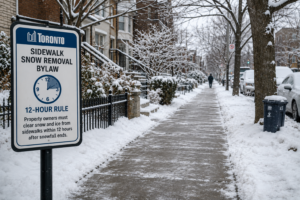
Most Toronto homeowners learn about the sidewalk snow removal bylaw in one of two ways. Either someone knocks on their door after a storm to tell them the sidewalk has not been cleared and a bylaw officer has been called, or they look it up on a Sunday evening in January after a heavy snowfall and suddenly realise the 12-hour window is almost closed.
This article explains the Toronto sidewalk clearing bylaw in full plain-language detail: what the law actually says, when the clock starts, what counts as compliant, who the rule applies to, what the fine is, the civil liability risk that sits behind it, how it compares to surrounding GTA municipalities, and how a snow removal contract eliminates it from your list of winter concerns entirely.
What the Law Actually Says
The sidewalk snow removal requirement in Toronto is set out in Toronto Municipal Code Chapter 719, Section 719-2. The exact language from the bylaw reads:
Every owner or occupant of any building must, within 12 hours after any fall of snow, rain or hail has ceased, clear away and completely remove snow and ice from any sidewalk on any highway in front of, alongside or at the rear of the building.
The same section also states that after the removal of snow and ice, if any portion of the sidewalk becomes slippery from any cause, the owner or occupant must immediately and as often as necessary apply ashes, sand, salt or some other suitable material so as to completely cover the slippery surface.
Three things in this language are worth paying specific attention to.
First: “after any fall of snow, rain or hail has ceased.” The 12-hour clock starts when the precipitation stops, not when it starts. If snow falls from 2am to 6am, you have until 6pm to clear the sidewalk. If it snows continuously from 8am to 4pm, the clock starts at 4pm and runs until 4am.
Second: “completely remove snow and ice.” The law requires full removal, not a narrow path. Shovelling a single-body-width track down the centre of the sidewalk does not meet the standard. The full width of the sidewalk adjacent to your property must be cleared.
Third: “in front of, alongside or at the rear of the building.” The obligation extends around corner properties. If your home sits on a corner lot in Rosedale, the Annex, Leaside or anywhere else in Toronto, you are responsible for the sidewalk frontage on both sides of the corner. On a large corner property with forty metres of combined frontage, this is a meaningful clearing obligation after every significant snowfall.
When the Bylaw Applies to You: The City Plowing Exception
This is the nuance most Toronto homeowners and landlords do not know, and understanding it correctly determines whether you are personally responsible for sidewalk clearing or not.
In 2022, the City of Toronto expanded its mechanical sidewalk snow plowing program across the city. Where the City plows the sidewalk adjacent to your property, the private property obligation under Chapter 719 does not apply. You are not required to clear a sidewalk that city equipment has already cleared.
The important qualifier is “where the City plows.” On most residential side streets across Toronto, including the majority of streets in North York, Etobicoke, Scarborough and established residential areas of Midtown, the City does not plow sidewalks. The mechanical sidewalk program primarily covers major and collector roads. On residential side streets, the responsibility falls entirely to the property owner.
How do you find out whether your street is included in the City’s sidewalk clearing program? The City of Toronto’s winter operations page at toronto.ca allows you to check your specific address, or you can call 311 and confirm for your property. If your street is not included, Chapter 719 applies to you after every snowfall. If it is included, the city clears the sidewalk and your obligation under the bylaw is relieved for that surface.
This matters because a significant number of Toronto homeowners assume, incorrectly, that the city handles sidewalk clearing throughout the city. For most residential streets, that assumption is wrong and the 12-hour obligation belongs to the property owner.
The Fine for Non-Compliance
Those caught not clearing snow from public property can face a fine of $105, plus a $30 surcharge, for a total of $135 for the first offence.
This is the confirmed fine amount. Some sources have reported higher amounts for repeated or severe non-compliance, but $135 is the established base penalty for a first offence under Chapter 719 enforcement.
Beyond the fine itself, the City of Toronto may also clear the sidewalk at the property owner’s expense if the owner has not done so within the required timeframe. This means you pay the fine and the City bills you for the clearing cost on top of it.
Bylaw enforcement in Toronto operates on a complaint-driven basis for residential properties in most cases. A neighbour, a passer-by or a property owner on an adjacent lot can contact 311 to report an uncleaned sidewalk. A bylaw officer will attend and, if the sidewalk is uncleared beyond the 12-hour window, a ticket is issued.
The City’s approach is generally to notify the property owner first and allow an opportunity to comply before ticketing. However, this is not guaranteed in all circumstances, particularly where a sidewalk has been visibly uncleared for an extended period after a significant storm.
The Civil Liability Dimension
The fine is not the only financial risk attached to non-compliance. The civil liability issue is less commonly understood and potentially more significant.
In many cities in Ontario, including Toronto, by-laws have been enacted which require property owners to clear the snow and ice from adjacent municipal sidewalks. Failure to comply with the by-law in Toronto typically results in a fine issued by the city. However, the broader legal picture in Ontario is that municipalities are ultimately responsible for injuries which occur on slippery sidewalks. In limited situations, liability for a fall on a municipal sidewalk may also fall on a homeowner, if the homeowner’s actions created the hazard on the sidewalk.
The practical implication for Toronto homeowners is this: while the municipality bears primary liability for an injury on an uncleared sidewalk in most circumstances, a property owner who has clearly failed to comply with Chapter 719, and where that failure is directly connected to a slip-and-fall incident, may face a strengthened case in civil litigation. The bylaw creates a documented legal standard, and a clearly uncleared sidewalk several hours after snowfall stops is evidence of a failure to meet that standard.
For landlords managing rental properties in Toronto, this dimension of the bylaw is particularly relevant. A rental property with an uncleared sidewalk represents an obligation that sits with the property owner regardless of whether the tenant cleared it, and an injury on that sidewalk creates a liability question the property owner needs to address.
The Private Property Rule: The Separate 24-Hour Obligation
Chapter 719 governs the public sidewalk adjacent to your property. There is a separate obligation under the Property Standards Bylaw that applies to private property surfaces.
Driveways, parking spaces, steps, ramps and landings on private property must be cleared within 24 hours after snowfall ends to provide safe access for people and vehicles.
This means a Toronto homeowner faces two distinct timelines after a snowfall:
12 hours: The public sidewalk adjacent to the property.
24 hours: Private property surfaces including driveways, steps, ramps and parking areas.
The sidewalk obligation is shorter and carries the public enforcement and liability dimensions described above. The private property obligation is longer but still carries its own compliance and access requirements.
How Toronto Compares to Surrounding GTA Municipalities
If you own property in multiple parts of the GTA, or if you are relocating from one municipality to another, the clearing timelines are not uniform. Here is how the major GTA municipalities compare.
| Municipality | Sidewalk Rule | Private Property |
| City of Toronto | 12 hours after snowfall ends | 24 hours |
| City of Mississauga (Peel Region) | 24 hours after snowfall ends | 24 hours |
| City of Markham (York Region) | 24 hours after snowfall ends | 24 hours |
| City of Vaughan (York Region) | 24 hours after snowfall ends | 24 hours |
| Town of Richmond Hill (York Region) | 24 hours after snowfall ends | 24 hours |
| City of Brampton (Peel Region) | 24 hours after snowfall ends | 24 hours |
| City of Oakville (Halton Region) | 24 hours after snowfall ends | 24 hours |
Toronto’s 12-hour requirement is the shortest clearing window of any major GTA municipality, and it applies to properties on streets not covered by the City’s mechanical sidewalk plowing program, which is the majority of residential streets.
For Thornhill properties, which straddle the boundary between the City of Vaughan (York Region) and the City of Toronto boundary near Steeles Avenue, confirming which municipality your specific address falls under determines which bylaw applies.
Corner Lots: The Bigger Obligation
A standard detached home with a single sidewalk frontage faces a clearing obligation for the footpath in front of the property. A corner lot doubles or more than doubles that obligation.
A corner property in Davisville Village, the Annex, Leaside, Forest Hill or anywhere across Toronto with frontage on two streets may have 30 to 50 metres or more of combined sidewalk length to clear within the 12-hour window. On a property where the driveway exits on one street and the garden frontage faces another, the clearing obligation runs along both edges.
For landlords with corner lot rental properties, this obligation is particularly important because the clearing window is short, the physical task is substantial and the property owner may not be present when the snow stops. A snow removal contract that explicitly covers the full sidewalk perimeter of a corner property addresses this without requiring the owner to manage it personally.
What This Means for Landlords and Property Managers
Section 719-2 binds both the owner and the occupant of a building. For rental properties in Toronto, this creates a question about who is ultimately responsible when a sidewalk is not cleared.
From a legal and practical standpoint, the property owner is the party with the financial and legal exposure if enforcement occurs or a civil action follows. A lease clause that assigns sidewalk clearing responsibility to a tenant does not transfer the bylaw obligation to the tenant in the city’s eyes. If the sidewalk is uncleared and a ticket is issued, it is the property owner who faces the fine and the city clearing bill.
For landlords managing properties in Toronto from a distance, the 12-hour window is particularly challenging. A storm that stops at 2am triggers an obligation that must be met by 2pm the same day, regardless of the landlord’s location or schedule. A snow removal contract that covers the property and runs automatically after every qualifying snowfall is the practical solution that most Toronto landlords maintaining property in areas not covered by city sidewalk plowing eventually arrive at.
How a Snow Removal Contract Handles This
The simplest and most practical way to meet the Chapter 719 obligation consistently through a Toronto winter is a seasonal snow removal contract that includes sidewalk clearing as part of the scope.
A properly structured contract runs automatically after every qualifying snowfall, clearing the driveway and the adjacent public sidewalk within the contracted response window. You receive service confirmation when the property has been cleared. The 12-hour obligation is met without you monitoring the weather, tracking when the snow stopped or coordinating clearing yourself.
The guide to seasonal versus per-visit snow removal contracts covers the cost comparison between contract types and explains which arrangement typically provides better value for Toronto residential properties.
My Property Care provides residential snow removal across Toronto and the GTA with seasonal contracts that include sidewalk clearing across the properties we service. Seasonal routes fill before mid-November, and the booking guide explains why September and October are the right time to secure coverage rather than waiting for the first snowfall.
Call 289-301-0925 or fill in the quote form for a free, no-obligation estimate based on your property and its specific sidewalk obligations.
Published: November 2026 | My Property Care serves Toronto, Mississauga, Markham, Etobicoke, Vaughan, Thornhill, Richmond Hill, North York, Scarborough, Brampton and Oakville.