
6 Warning Signs You Need Duct Cleaning in Your Toronto Home (Do Not Ignore Number 4)
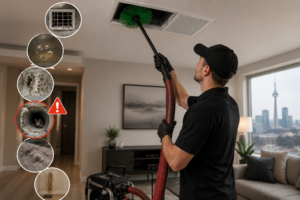
The duct system in your home is invisible. It runs through the walls, ceiling and floor cavities of the building, delivers conditioned air to every room and returns it to the furnace on a cycle that runs continuously through a Toronto winter. Because you cannot see inside it, most homeowners have no reliable way of knowing what is in there until one of the following warning signs appears.
The problem with duct-related warning signs is that they mimic other things. Dust mimics poor housekeeping habits. Musty smells get blamed on carpets or the basement. Allergy symptoms get chalked up to the season. This is how ductwork that genuinely needs cleaning goes unaddressed for years in homes across Etobicoke, North York, Scarborough, Markham and throughout the GTA, quietly affecting air quality and HVAC performance through every heating cycle.
Here are the six signs that your Toronto home is telling you the duct system needs attention, and the one that matters most.
Sign 1: Dust Returns to Surfaces Within 24 to 48 Hours of Cleaning
You dust the living room on Saturday. By Monday the surfaces are noticeably dusty again. You wipe down the dining table and within two days it needs doing again. You have accepted this as normal and developed a weekly dusting routine that never quite keeps ahead of it.
This pattern is one of the clearest indicators that dust is being actively distributed through the home by the HVAC system rather than simply settling from the air. When the furnace or air conditioning runs, air is drawn through the return vents, moves through the duct system and is pushed out through the supply registers into each room. Whatever has accumulated in the ducts goes with it.
Ordinary dust levels between cleanings are expected. The specific signal here is the speed of return and the volume. If surfaces you cleaned two days ago already need dusting again, and this is consistent rather than occasional, the HVAC system is the most likely cause rather than anything else in the home.
The test is straightforward. On a day when the furnace has been running, hold a white cloth near a supply register when the system starts. If the cloth picks up visible grey or dusty material in the first thirty seconds of airflow, the duct system is distributing rather than delivering clean air.
Sign 2: A Musty or Stale Smell When the Furnace or AC Starts Up
The smell appears reliably at the same moment: when the furnace kicks on first thing in the morning in October, or when the air conditioning starts on the first hot day in May. It is not a burning smell, which would indicate a mechanical issue with the system. It is a flat, slightly stale, damp or earthy odour that spreads through the house with the first few minutes of airflow and then fades as the system runs.
Musty or earthy odour from vents when heating or cooling starts is a common warning sign of biological matter inside the duct system. Mold, mildew, bacteria and accumulated biological debris that sit undisturbed in the ductwork between seasons get disturbed when airflow resumes and release that characteristic smell into the living space.
In Toronto homes that have been sealed through the winter and then opened for spring, or that start the heating season in October after months of summer air conditioning, this smell appearing at the first furnace cycle of the season is a specific and recognisable indicator.
The smell does not necessarily mean there is active mold throughout the duct system. It does mean there is biological material in the ducts that is being distributed with the air. That material, whatever its source, belongs in a duct cleaning rather than in the air your household is breathing through a Toronto winter.
Sign 3: Rooms That Never Reach the Temperature on the Thermostat
The upstairs bedrooms in the back of the house are always cold in winter and stuffy in summer. The main floor consistently reaches the set temperature but the upper floor needs extra blankets through January regardless of where the thermostat is set. This has been the case for several winters and you have accepted it as a quirk of the house rather than a maintenance symptom.
When ducts accumulate significant debris buildup, the restriction reduces the volume of conditioned air that reaches the furthest registers from the furnace. The rooms closest to the air handler receive adequate airflow. The rooms at the end of longer duct runs receive less, because the pressure required to push air through restricted ductwork to the far end of the system is greater than the blower produces efficiently.
If some rooms in your home are consistently colder or warmer than others, it could be a sign of uneven airflow caused by dirty air ducts.
This sign is commonly misdiagnosed as an insulation problem, a window sealing issue or simply a feature of how the house is built. In many Toronto homes, particularly in multi-storey detached houses in North York, Etobicoke and Scarborough where long duct runs serve bedrooms at the far end of the floor plan, restricted duct airflow is one of the first things worth investigating before more expensive structural solutions are considered.
Sign 4: Your Symptoms Are Worse at Home Than Outside (Do Not Ignore This One)
This is the sign that gets overlooked most often and most consequentially. It is also the one that most accurately points to the duct system as the source of the problem.
The pattern is specific: you sneeze more indoors than outdoors. Your eyes are more irritated in your own home than in other buildings. Your morning congestion clears up once you have been outside for twenty minutes and returns within an hour of getting home. A household member who has been diagnosed with allergies notices their symptoms are more controlled on days spent outside the house than on days spent inside. Symptoms get noticeably worse when the furnace or air conditioning has been running.
If coughing, sneezing, throat irritation, or nighttime congestion ramps up when the system is on, the HVAC side of the house deserves a closer look. When symptoms seem tied to time spent indoors, the duct system becomes part of the investigation. The ducts may be carrying contaminants from a source you cannot see.
Health Canada has noted that indoor air can contain pollutants from dust, particles and other sources that build up inside the home, often at higher levels than outdoor air in some conditions. Could your duct system be part of the reason someone in the house feels worse indoors than out?
Most people who experience this pattern attribute it to seasonal allergies for months or years before connecting it to the home environment specifically. The distinguishing factor is the pattern: consistently better outside, consistently worse inside, and worse when the HVAC is running specifically rather than in all indoor environments. If this describes your household, the duct system is where the investigation should start.
For Toronto families with young children, for households with elderly occupants or anyone with asthma or compromised respiratory health, this sign matters more urgently. The same duct system that runs from October through April without interruption is the mechanism distributing whatever it contains through every room the family occupies through the coldest months of the year.
Sign 5: Dark, Grey or Black Residue Around Supply Vents
The metal grilles over supply registers pick up surface dust in normal operation. That is unremarkable. What is not normal is dark staining, black smudging or grey discolouration on the walls, ceiling or floor immediately surrounding the register opening.
Dust or debris that visibly pushes into the room when the system starts is different from ordinary surface accumulation. That suggests buildup, disturbance inside the duct, or return-side issues.
The dark residue around registers is a visible indicator of what is moving through the duct system and what is being deposited on surfaces with each airflow cycle. When this discolouration appears on painted walls around a supply register, the volume of material coming through the duct is significant enough to leave visible deposits on the surrounding surface.
Checking registers for this sign takes thirty seconds. Run a white cloth along the inside edge of a supply register. Dark material on the cloth, beyond light surface dust, indicates duct debris at the opening that needs professional inspection and cleaning.
Sign 6: Energy Bills Rising Without a Clear Explanation
Your gas and electricity costs have increased over the past two or three winters compared to equivalent periods in previous years. There has been no rate change significant enough to account for the full difference. Your usage habits have not changed. The house feels the same or slightly less comfortable despite the higher bills.
Accumulated debris and dust restrict the passage of air through the ductwork, causing your HVAC system to work harder to maintain the desired temperature, which can increase energy bills.
A furnace that is running longer cycles to maintain the set temperature because restricted ductwork is reducing its effective delivery of conditioned air uses more energy per degree of heating achieved. This increase is gradual enough that it typically happens below the threshold of immediate concern. When a homeowner looks back at their energy bills across three or four winters and notices a consistent upward trend without an equivalent lifestyle change or utility rate change, HVAC performance is one of the first areas worth assessing.
Duct cleaning alone does not resolve all HVAC efficiency issues. But for a Toronto home where the duct system has not been cleaned in five or more years, and where other signs on this list are also present, cleaning is a logical first step before more significant and expensive HVAC maintenance is considered.
Why These Signs Matter More in Toronto Than in Most Canadian Cities
Toronto homes are sealed from October through April. Indoor air in Canadian homes can be more polluted than outdoor air, making regular duct cleaning essential for eliminating dust, allergens, pet dander, mold spores, and other contaminants that accumulate deep within HVAC systems. In a GTA home where windows are closed from October through April, the duct system is the primary mechanism for air movement through every room through six months of continuous heating. Whatever accumulates in the system circulates through the household for that entire period.
The older housing stock across Etobicoke, North York, Scarborough and the established residential areas of Midtown Toronto adds a specific dimension: many homes from the 1970s and 1980s have forced air systems from original installation or early replacement that have never had a professional clean. For these homes, the six signs above are not diagnostic indicators of a recent problem. They are the accumulated result of decades of operation without intervention.
Post-renovation households in Toronto are also a specific category. Construction dust from drywall cutting, sanding and demolition enters duct systems even when vents are covered. For a home that has undergone any significant renovation without a subsequent duct clean, the construction debris question is worth addressing before it circulates through the living space through another heating season.
What to Do If You Recognise These Signs
One or two signs appearing occasionally may not indicate an urgent need for cleaning. Three or more signs appearing consistently, or Sign 4 appearing at all in a household with respiratory health concerns, warrant professional assessment rather than waiting for the next scheduled cleaning interval.
If you can smell it, see it, or feel uneven airflow, you have enough reason to inspect. You do not need to wait for a major breakdown.
My Property Care provides professional duct cleaning for homes and rental properties across Toronto and the GTA, covering the full air distribution system with the inspection and negative pressure extraction process that addresses what standard surface cleaning cannot reach. If you are unsure how long it has been since the system was last cleaned, or you have never had it done, the guide to how often air ducts should be cleaned in a Toronto home gives a realistic picture of the recommended intervals for different household situations.
Call 289-301-0925 or fill in the quote form for a free, no-obligation assessment of your property.
Published: July 2026 | My Property Care serves Toronto, Mississauga, Markham, Etobicoke, Vaughan, Thornhill, Richmond Hill, North York, Scarborough, Brampton and Oakville.