
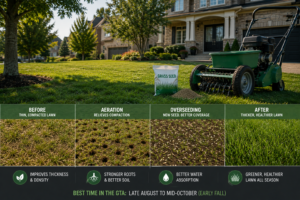
There is a specific pattern that plays out on GTA lawns across the city every few years. A lawn that was thick and green when the family first moved in gradually becomes thinner, patchier and slower to recover from summer heat or a rough winter. The mowing still happens. The watering still happens. Nothing obvious has changed. But the lawn just does not look the way it used to.
This is not always a problem that mowing and watering can solve. Compacted soil and thinning grass coverage are the two most common underlying causes of a GTA lawn declining over time, and neither one responds to surface-level maintenance. Aeration and overseeding address both directly.
What Core Aeration Is
Core aeration is a mechanical process that removes small plugs of soil from the lawn surface throughout the treatment area. A core aerator, which can be a walk-behind machine or a ride-on unit depending on the property size, pulls cylindrical plugs of soil from the ground and leaves them on the surface. The holes created by this process are typically 5 to 10 cm deep and roughly 1 cm in diameter, spaced approximately 8 to 15 cm apart across the lawn.
The plugs left on the surface are not debris to be removed. They decompose within two to three weeks, returning nutrients to the turf and adding a light top-dressing effect across the lawn surface.
What aeration is solving is compaction, which is the condition where soil particles are pressed so tightly together that grass roots cannot push through, and where water, air and nutrients cannot move down into the root zone at the rate the grass needs them. Compaction happens gradually through regular foot traffic, pet activity, children playing, equipment weight and, in the GTA specifically, the weight of snow load through winter. It is invisible from the surface until the lawn starts showing the consequences.
The screwdriver test is the most practical self-assessment for compaction. Push a standard screwdriver into moist soil on your lawn. If it meets resistance before reaching 10 cm depth, the soil is compacted and aeration will produce visible results. Most GTA homeowners who do this test on their existing lawn are surprised by how quickly they hit resistance.
What Overseeding Is
Overseeding is the process of spreading grass seed across an existing lawn to introduce new grass plants into areas that have thinned, to fill bare patches and to thicken a lawn that has become sparse over time. Unlike sodding, which replaces the lawn surface entirely, overseeding works within and alongside the existing turf.
Overseeding alone, without prior aeration, has a significant limitation: grass seed that lands on compacted, thatch-covered ground has poor soil contact and low germination rates. The seed either washes off the surface, dries out before establishing roots or gets eaten by birds before it reaches the soil.
Germination rates after aeration run 30 to 50 percent higher than overseeding into unprepared ground, because the aeration holes create the ideal environment: direct soil contact, moisture retention within the hole, and protection from the surface conditions that defeat ungerminated seed. This is why the two services are almost always discussed and delivered together.
Why GTA Lawns Need This More Than Most
Two factors specific to the GTA make aeration and overseeding more important here than in many other Canadian cities.
GTA soils are predominantly heavy clay. Unlike sandy or loamy soils that drain freely and resist compaction relatively well, clay soils compact quickly under pressure and stay compacted. Clay-heavy soils re-compact within a season under normal foot traffic, which means a single aeration session opens the soil temporarily and annual aeration is the maintenance that keeps clay lawns healthy long-term.
If your property is in Etobicoke, Scarborough, North York, Mississauga, Markham or Thornhill, there is a high probability your soil is clay-heavy. The tightly packed, slow-draining soil that shows up as puddling after rain and as thick, sticky mud during wet periods is the same soil that is working against your lawn’s root system between those visible wet events.
Toronto winters are specific in what they do to lawns. Five months of snow load compresses the soil surface across the entire lawn area, compacting the top layer beyond what growing-season foot traffic alone would produce. Road salt damage along driveway borders and walkway edges kills grass in strips that require overseeding to restore. Freeze-thaw cycling through winter creates frost heave in some areas and uneven settlement in others, disrupting the root zone. The combination of compaction, salt damage and surface disruption that a Toronto winter delivers to a lawn is the primary reason most GTA lawns benefit from annual aeration and overseeding rather than occasional treatment.
When to Aerate and Overseed: The GTA Window
This is the section where the most common mistake gets made, and it is worth being direct about it.
Most GTA homeowners who think about lawn renovation think of it as a spring task. Spring is when the lawn looks worst, spring is when the motivation to address it is highest, and spring is when a lot of lawn care activity happens visibly. But spring is the second-best window for aeration and overseeding, and for overseeding specifically, fall is dramatically more effective.
The optimal GTA window for aeration and overseeding is late August to mid-September, specifically late August to September 15 for the Toronto area.
The reason is grass biology. All standard Ontario lawn grasses, including Kentucky bluegrass, creeping red fescue and perennial ryegrass, are cool-season grasses. They germinate best at soil temperatures of 10 to 18 degrees Celsius. In the GTA, that soil temperature window in fall typically runs from late August to late September. Soil is still warm from summer, air temperatures are cooling down to reduce stress on new seedlings, fall rains provide consistent moisture, and the new grass has six to eight weeks of growing season before frost to establish a root system before winter dormancy.
Spring overseeding is competing with crabgrass and annual weeds that germinate in the same temperature conditions as grass seed, requiring either herbicide treatment or significant establishment advantage to succeed. Fall overseeding faces essentially no weed competition because annual weeds do not germinate in cooling fall temperatures.
There is a specific pattern that illustrates this: a client in Markham had their previous lawn service aerate every late May. Their bluegrass looked fine in spring but struggled every August. Cool-season grasses should be aerated in early fall, not spring, because they hit peak stress in summer and cannot recover from aeration wounds effectively. Switching to September aeration and overseeding produced a markedly different result by the following year.
Spring aeration is the appropriate choice in two situations: a lawn that is severely compacted and needs immediate relief to function through the growing season, or small spot repairs to bare patches where fall treatment was missed. Spring overseeding should be limited to small repairs only. Fall remains the best time for overseeding lawns across the GTA.
The Grass Seed Mix That Works for GTA Lawns
Seed selection matters for Ontario conditions. For GTA lawns, use a blend containing at least two of the following cool-season grass species: Kentucky bluegrass, creeping red fescue and perennial ryegrass. This combination provides complementary characteristics: bluegrass self-repairs through rhizome spread, fescue tolerates shade and drought, and ryegrass germinates quickly to provide fast coverage while the slower species establish.
Perennial ryegrass germinates in 7 to 10 days. Kentucky bluegrass takes 14 to 21 days. A blend using both means you see progress quickly from the ryegrass while the bluegrass establishes over the following weeks.
For GTA lawns with significant shade from mature trees, a higher fescue proportion in the mix is more appropriate than a standard sun blend. Fine fescues tolerate shade conditions that bluegrass handles poorly, and most GTA properties with mature tree canopy across Forest Hill, Rosedale, Leaside or the established suburbs of Mississauga and Markham need a shade-tolerant blend over a standard sun mix.
What the Professional Process Covers
When a professional aeration and overseeding service is done correctly on a GTA lawn, the sequence follows a specific order that maximises the benefit of both steps together.
The existing lawn is mowed shorter than the standard maintenance height before aeration, typically to around 4 to 5 cm, to reduce competition from existing grass for the new seed and to allow light to reach the soil surface. If thatch deeper than 1.5 cm is present, dethatching before aeration improves the effectiveness of both the aeration and the subsequent seeding.
Core aeration covers the full lawn area, with multiple passes over high-traffic areas that show more compaction. The soil plugs are left on the surface. Seed is broadcast immediately after aeration at the correct rate for the seed blend being used, ideally within the same day. The plugs on the surface and the moisture within the aeration holes create natural seed-to-soil contact without additional soil preparation.
After seeding, the lawn needs consistent moisture to support germination. Light watering twice daily for the first two to three weeks keeps the seeded area moist without washing the seed off the surface. New grass should not be mowed until it reaches at least 8 cm in height, and the first mow should remove no more than one third of the blade length.
How to Tell If Your Lawn Is Ready for This Treatment
A lawn that needs aeration and overseeding typically shows one or more of the following:
It is visibly thinner and patchier than it was three to four years ago without obvious disease or pest damage explaining the change. The soil feels hard underfoot in dry periods and the screwdriver test meets resistance before 10 cm. Water pools on the surface after rain rather than absorbing within a few minutes. Bare strips run along driveway borders and walkway edges from road salt damage through the previous winter. The lawn looks consistently better in spring than it does by August, which indicates the root system is shallow and stressed by summer conditions. Weeds are establishing in areas that previously held grass because the turf density is no longer thick enough to crowd them out.
Our lawn care and landscaping services across Toronto and the GTA include fall aeration and overseeding as part of the seasonal care cycle for residential and rental properties. Scheduling for the late August to mid-September window fills ahead of the season, and the service pairs naturally with the spring lawn care that prepares the lawn after winter. The spring lawn care checklist for GTA homeowners covers what happens at the other end of the lawn maintenance calendar.
Call 289-301-0925 or fill in the quote form for a free, no-obligation assessment of your lawn and what it needs going into this fall season.
Published: July 2026 | My Property Care serves Toronto, Mississauga, Markham, Etobicoke, Vaughan, Thornhill, Richmond Hill, North York, Scarborough, Brampton and Oakville.