
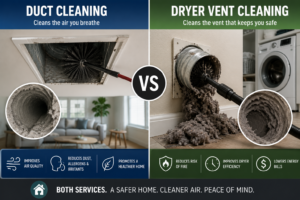
When a homeowner books a duct cleaning for their Toronto home, a reasonable number of them assume the dryer vent is part of the scope. It is not. These are two separate services addressing two entirely different systems in your home, with different equipment, different cleaning intervals, different consequences for neglect and different reasons why they matter to your household.
The confusion is understandable. Both involve ducts. Both involve a technician with vacuum equipment. Both get recommended by property maintenance companies. But that is roughly where the similarity ends, and understanding the distinction clearly is what allows you to maintain both properly rather than assuming one covers the other.
What HVAC Duct Cleaning Actually Is
Duct cleaning, sometimes called air duct cleaning or HVAC duct cleaning, refers to the professional cleaning of your home’s forced air distribution system. This is the network of supply ducts that deliver heated or cooled air to every room in the house, the return ducts that draw air back to the furnace or air handler, the main trunk lines that connect the distribution branches, and the plenum chambers surrounding the furnace cabinet.
The purpose of cleaning this system is to remove the accumulation of dust, pet dander, mold spores, biological debris and fine particulate matter that builds up inside ductwork over years of operation. Every time the furnace or air conditioning system runs, whatever is inside the duct system circulates through every room in the house. The primary concern with neglected HVAC ductwork is indoor air quality: the health and comfort of the people living in the home.
The equipment used for HVAC duct cleaning creates negative pressure throughout the duct system using industrial vacuum equipment. This suction extracts loosened debris toward a collection unit rather than dispersing it through the house during cleaning. The process covers every accessible duct run in the distribution system and typically takes three to five hours on a standard residential property.
The recommended cleaning interval for most GTA homes is every three to five years. Homes with pets, allergy sufferers, post-renovation debris in the system or original ductwork that has never been cleaned benefit from the shorter end of that interval.
What Dryer Vent Cleaning Actually Is
Dryer vent cleaning is the cleaning of a single exhaust duct: the line running from the back of your clothes dryer to the exterior of the home. This duct carries hot, moisture-laden air and lint from the dryer drum to the outside with every load of laundry.
The material removed from a dryer vent is primarily lint, which is the fibrous residue from fabric that the dryer’s drum filter does not fully capture. Every load of laundry generates lint that escapes past the lint trap and begins coating the interior walls of the exhaust duct. Over months and years, this lint accumulates into layers that progressively restrict airflow, trap heat inside the dryer and create a combustible environment adjacent to the dryer’s heating element.
The equipment used for dryer vent cleaning is a flexible rotating brush combined with a vacuum, designed to navigate the bends and length of the exhaust run and extract the accumulated lint. The process typically takes under an hour for a straightforward residential vent run.
The primary concern with a neglected dryer vent is not air quality. It is fire.
The Core Difference: Health vs. Fire Safety
This is the distinction that changes how both services should be prioritised and maintained.
HVAC duct cleaning is a health, comfort and efficiency service. A neglected duct system produces gradually worsening indoor air quality, increasingly uneven heating and cooling distribution, and rising energy consumption as the system works harder through restricted airflow. These consequences develop slowly over years and are unlikely to produce a sudden emergency.
Dryer vent cleaning is a fire safety service. A blocked dryer vent creates a heat accumulation environment where highly combustible lint sits adjacent to the heat source of the appliance. Failure to clean dryer vents is the leading cause of approximately 15,970 home structure fires annually across North America, according to U.S. Fire Administration data. In North America, fire services respond to approximately 16,000 dryer-related structure fires every year, with property losses exceeding $230 million annually. Toronto Fire’s public-safety material links residential dryer fires directly to poor maintenance, and Ontario Fire Marshal data documents dryer-related fires across the province over multiple reporting periods.
In a dense Toronto neighbourhood, where detached homes, semi-detached properties and townhouses sit in close proximity to one another, a dryer fire that begins in one unit does not stay contained to that unit. The consequences of a blocked dryer vent in GTA housing stock are more serious than the same situation in a rural property with separation from neighbouring buildings.
This distinction matters for scheduling. HVAC duct cleaning can reasonably be planned on a multi-year cycle. Dryer vent cleaning should be treated as an annual maintenance item for most GTA households, with more frequent attention for homes with complex vent runs.
Why GTA Properties Have Specific Dryer Vent Risk Factors
Several characteristics of Toronto’s housing stock make dryer vent blockage more likely and dryer vent fires a more serious concern than in newer construction or simpler building configurations.
Older homes with longer vent runs. Many GTA homes built in the 1970s and 1980s across Etobicoke, Scarborough, North York, Brownridge and similar established residential areas have laundry facilities in the basement, meaning the dryer vent must travel a greater horizontal distance to reach the exterior wall. Longer runs accumulate lint more quickly because there is more interior surface for lint to adhere to, and airflow pressure decreases across longer distances, reducing the velocity that carries lint out of the duct.
Multiple 90-degree bends. Every bend in a dryer vent run reduces airflow and creates a location where lint accumulates before being carried further. A vent run with three or four 90-degree bends, common in basement laundry rooms routed around structural elements in older Toronto homes, requires more frequent cleaning than a short, straight wall-exit configuration in a newer build.
Roof terminations. Some GTA homes vent the dryer through the roof rather than a side wall. This configuration requires the dryer to push hot, moisture-laden air upward against gravity, which reduces efficiency and creates more surface area for lint adherence along the vertical section of the run. Roof-terminated vents are harder to inspect visually and often go uncleaned longer than wall-exit vents because homeowners cannot easily see whether the exterior termination is functioning properly.
GTA winter conditions. In winter, the warm moist air from a dryer hits cold duct surfaces and causes moisture to condense within the vent run. That moisture makes lint heavier and stickier than dry lint, which means it adheres more firmly to duct surfaces and is harder to clear. GTA summers also create conditions where humid air makes lint denser. Both seasons compound the accumulation rate beyond what a standard lint assessment based on usage frequency alone would suggest.
Townhouses and condos with shared laundry venting. In some GTA multi-unit configurations, multiple dryers share sections of exhaust vent infrastructure. Shared systems depend on every section functioning correctly. If one unit’s vent is severely restricted, airflow from other units is affected, and lint accumulation accelerates across the shared section.
The Warning Signs for Each System
Signs Your HVAC Ducts Need Cleaning
Dust returns to surfaces within 24 to 48 hours of cleaning. Rooms that consistently fail to reach the temperature set on the thermostat. A musty or stale smell when the furnace or air conditioning starts. Dark, grey or dusty residue visible around supply registers. Energy bills rising without a clear change in usage or utility rates. A household member experiencing indoor allergy or respiratory symptoms that improve when they leave the home. These are covered in detail in the six warning signs you need duct cleaning guide.
Signs Your Dryer Vent Needs Cleaning
The dryer takes noticeably longer to dry a normal load than it did previously. The outside of the dryer feels hot to the touch during operation. Clothes come out hotter than usual at the end of a cycle or still feel damp after a full run. A burning smell appears during the first few minutes of operation. The exterior vent hood flap does not open or barely opens when the dryer is running, indicating restricted airflow. It has been more than twelve months since the last professional cleaning.
If your laundry is taking two cycles to dry what previously took one, the dryer itself may still be functioning correctly. The vent run is the more likely explanation and a significantly cheaper diagnosis than replacing the appliance.
How Often You Need Each Service
| Service | Recommended Interval | When to Accelerate |
| HVAC Duct Cleaning | Every 3 to 5 years | Pets, allergies, post-renovation, never cleaned |
| Dryer Vent Cleaning | Every 12 months | Complex runs, roof exit, family of 4 or more, heavy laundry use |
These intervals represent standard residential maintenance in GTA conditions. A household of two adults with no pets, a short straight dryer vent and a newer home can extend both intervals comfortably. A family of five with pets, a basement laundry room and a vent run with multiple bends benefits from dryer vent cleaning every six to twelve months and HVAC duct cleaning at the shorter three-year interval.
Why Booking Both Together Makes Practical Sense
Neither service is more important than the other. They maintain different systems with different purposes. What makes practical sense is booking them in the same service window when either one is due.
The equipment for dryer vent cleaning is different from the equipment for HVAC duct cleaning, but the scheduling logic is the same. A technician already on site for HVAC duct cleaning can complete the dryer vent cleaning as a single appointment rather than a separate call-out. Most GTA homeowners booking HVAC duct cleaning find the add-on cost for the dryer vent service considerably less than a separate visit because the minimum call-out cost applies only once across both services.
Fall is the natural timing for both. HVAC duct cleaning before the heating season eliminates the accumulation inside the ductwork before it circulates through the home for six months of closed-up winter heating. Dryer vent cleaning before winter addresses the seasonal lint accumulation before GTA winter conditions make the vent run more susceptible to moisture-related blockage.
The Honest Summary
HVAC duct cleaning and dryer vent cleaning are not interchangeable and neither one substitutes for the other.
Booking a duct clean without addressing the dryer vent leaves a fire risk unaddressed. Booking a dryer vent clean without addressing HVAC ductwork leaves indoor air quality and system efficiency unaddressed. Most GTA homes need both services maintained, just on different schedules.
My Property Care provides professional air duct cleaning for homes across Toronto and the GTA, covering the full HVAC distribution system with dryer vent cleaning available as a combined service in the same visit. For a detailed guide on the recommended frequency for HVAC duct cleaning in GTA homes, the how often should air ducts be cleaned in a Toronto home article covers the intervals and the specific household factors that should shorten them.
Call 289-301-0925 or fill in the quote form for a combined HVAC duct and dryer vent clean quote for your specific property.
Published: July 2026 | My Property Care serves Toronto, Mississauga, Markham, Etobicoke, Vaughan, Thornhill, Richmond Hill, North York, Scarborough, Brampton and Oakville.