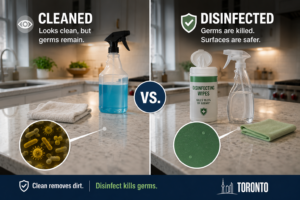
Most people who describe their home as clean mean it looks tidy, surfaces have been wiped, floors have been mopped and visible dirt has been removed. A reasonable number of those same people would also describe their home as disinfected, on the assumption that a thorough clean achieves both outcomes simultaneously.
It does not. Cleaning and disinfecting are two distinct processes with different mechanisms, different products and completely different outcomes for the pathogens and bacteria living on the surfaces of your home. Understanding the difference is not a hygiene niche concern. For families with young children, for elderly household members, for anyone who has had a serious illness move through the home and for Toronto homeowners and landlords preparing a property for new occupants, it determines whether a genuinely hazardous surface situation has actually been resolved or simply made to look cleaner.
The Three Levels: Cleaning, Sanitizing, Disinfecting
These three terms are used interchangeably in everyday conversation. They are not interchangeable in practice.
Cleaning removes visible dirt, dust, grease and residue through physical action using detergent and water. It improves the appearance of a surface and reduces the overall microbial load by physically removing some bacteria along with the dirt. It does not kill bacteria. It does not kill viruses. It is the essential first step before any effective disinfection, because organic matter on surfaces can interfere with disinfectant chemistry and reduce its effectiveness. Cleaning does not kill microorganisms. It only removes them.
Sanitizing reduces bacteria to levels considered safe by public health standards. It is a step up from cleaning, using chemical agents such as dilute bleach or alcohol-based products that reduce the bacterial count on a surface without necessarily eliminating it. Sanitizers are typically used on food-contact surfaces. They are not certified to kill all viruses or the full spectrum of pathogens that disinfection addresses. Sanitizing lowers the number of germs on a surface to a safe level as defined by public health standards. Sanitizers can reduce bacteria to safe levels, but may not be effective against viruses.
Disinfecting kills a broad spectrum of pathogens, including bacteria, viruses and fungi, using Health Canada-approved products applied at the correct concentration and with the required contact time. Disinfecting goes a step further by using chemicals to kill a wider range of microorganisms on hard, non-porous surfaces when used according to label directions.
Most homes in Toronto are regularly cleaned. Few are regularly sanitized in any meaningful sense. Fewer still are disinfected, in the way the word actually means, at any point in the year.
What Your Current Cleaning Products Actually Do
Walk through the cleaning products under most Toronto kitchen and bathroom sinks and you will find a mix of all-purpose cleaners, surface sprays, bathroom cleaners and possibly a container of disinfectant wipes. The label on any of these products tells you exactly what it is certified to do, but most homeowners read the marketing headline rather than the product classification.
All-purpose cleaners including most Pine-Sol, Mr. Clean and equivalent products are cleaners. They remove dirt and grease. They have no antimicrobial certification. A cleaner removes dust, soil, grease and residue. It may improve appearance and prepare a surface for disinfection, but it does not automatically come with an antimicrobial claim.
Antibacterial sprays and wipes are often assumed to be disinfectants. Many are not certified to the disinfectant standard. They reduce bacterial populations but may not achieve the kill claims required for certification as a disinfectant. Only disinfectants approved by regulatory bodies like Health Canada with valid Drug Identification Numbers should be used where disinfection is genuinely required. Household products are a different regulatory category from hospital-grade disinfectants.
In Canada, hospital grade means a disinfectant with a Drug Identification Number from Health Canada and approval for use as a low-level disinfectant in Canadian hospitals. Household cleaning products means all-purpose cleaners, polishes, wipes and dust-removal products intended for home use. These are distinct regulatory categories under the Food and Drugs Act. A product that does not carry a DIN cannot make the kill claims that a certified disinfectant makes.
The Contact Time Problem Almost Nobody Knows About
Here is the single most impactful piece of practical information in this article, and the one that changes how most people think about the cleaning they do at home.
Every disinfectant product has a required contact time, also called a dwell time. This is the minimum amount of time the product must remain wet on the surface to achieve the certified kill rate stated on the label. Many disinfectants have contact times of between one and ten minutes. Some require longer.
Most people apply a disinfectant spray to a surface, let it sit for a few seconds while they spray another surface, and then wipe it off. In most cases, the required contact time has not been met. The surface has been cleaned. The bacterial and viral reduction claimed on the label has not been achieved because the product was wiped away before it completed its mechanism of action.
There are even different levels of disinfectants: limited, broad-spectrum and hospital-grade. Many disinfectants contain bleach or other strong ingredients. The most important thing to remember about any of them is that contact time matters. A disinfectant applied for ten seconds does not produce the same result as a disinfectant applied for the required contact period.
Professional disinfection accounts for this explicitly. Hospital-grade products are applied at the correct concentration, allowed to remain on the surface for the certified dwell time, and removed correctly. This is not a minor technical distinction. It is the difference between a surface that has been visibly treated and a surface that has actually been disinfected.
The Surfaces in Your Toronto Home That Need More Than Cleaning
Most surfaces in a home need regular cleaning. A specific subset benefits from periodic disinfection, and a smaller subset in certain situations requires it.
High-touch surfaces are the starting point. Door handles, light switches, tap handles, toilet flush mechanisms, refrigerator doors and drawer pulls are touched by every member of the household multiple times daily. Whatever is on hands transfers to these surfaces and from these surfaces to the next pair of hands. Cleaning these surfaces removes visible contamination. Disinfecting them eliminates the pathogen transfer risk.
Bathroom surfaces including toilet bowls, toilet seats, tap fixtures and shower doors carry a specific bacterial and viral load that regular cleaning products do not eliminate at the concentrations and contact times most people use. E. coli, norovirus and influenza viruses survive on bathroom surfaces for hours to days after contamination.
Kitchen surfaces in contact with raw meat and poultry require disinfection rather than cleaning because the pathogens present in raw protein, Salmonella and Campylobacter primarily, are not eliminated by soap and water at typical household application levels.
Floors and lower surfaces accessible to young children and pets carry the full accumulation of whatever has been tracked in from outside, crawled across by children or stepped on by pets. For Toronto homes from November through March, this includes road salt residue, grit and whatever outdoor biological material has been carried in on boots and paws.
When Your Toronto Home Genuinely Needs Professional Disinfection
Routine cleaning is appropriate for everyday maintenance. There are specific situations where professional disinfection is the correct response rather than an upgraded cleaning session.
After a serious illness in the household. When a family member has had influenza, COVID-19, norovirus or any other highly contagious illness, the pathogens responsible for that illness are present on surfaces throughout the home, in the bedding, on door handles and in the bathroom, at concentrations that persist for hours to days after the individual recovers. A professional disinfection treatment using hospital-grade products addresses this systematically and eliminates the ongoing transmission risk within the household that cleaning alone does not.
Before moving into a new Toronto property. The previous occupants of any property leave biological material, allergens, bacteria and pathogens on surfaces that a pre-tenancy clean does not eliminate. Professional disinfection before furniture is moved in treats every accessible surface with products certified to kill what cleaning leaves behind. For Toronto families moving into an older home or a rental that has had multiple previous occupants, this is one of the highest-value hygiene investments available before establishing a new household.
For households with vulnerable occupants. Elderly family members, individuals undergoing chemotherapy, residents with autoimmune conditions and young infants are at significantly higher risk from the pathogen load that accumulates on residential surfaces through daily use. For these households, periodic professional disinfection reduces the environmental pathogen load to a level that matters directly for health, not just for appearance.
After water damage. Flood, sewage backup or any moisture event that brings external water into contact with interior surfaces introduces biological contamination that routine cleaning cannot address. The bacteria and mould spores that accompany water damage events require professional-grade treatment to eliminate.
Rental property turnovers. For Toronto landlords preparing a unit for incoming tenants, a professional disinfection clean between occupancies provides the hygiene baseline that a standard pre-tenancy clean does not. High-quality tenants increasingly expect a professionally prepared property, and the documentation from a professional disinfection service supports the landlord’s maintenance record under the Residential Tenancies Act.
How to Tell If a Product Is Genuinely a Disinfectant in Canada
Two practical checks apply to any product you want to verify as a legitimate disinfectant for residential use in Canada.
Check for the Drug Identification Number. A Health Canada-approved disinfectant carries an eight-digit DIN on the label. This number confirms the product has been reviewed and approved by Health Canada for its claimed antimicrobial function. A product with marketing language about killing germs but no DIN has not passed the regulatory review required to make certified kill claims.
Read the actual kill claims on the label. A legitimate disinfectant will list specific organisms it is certified to kill, including named bacteria and viruses, at specific concentrations and within specific contact times. Vague language about “freshening” or “fighting odour” is not a disinfection claim. Specific organism names with contact times are.
Most products under the average kitchen sink do not carry a DIN and do not make certified kill claims. Most people are cleaning their homes and calling it disinfecting.
The Practical Starting Point for Toronto Homeowners
For most households, the answer is not to overhaul every cleaning product. It is to understand the distinction, identify the situations where disinfection is genuinely appropriate and make informed decisions about when a professional service delivers what household products cannot.
Professional disinfection using hospital-grade products applied at the correct concentration and contact time is what the word “disinfected” actually means, and it is meaningfully different from what a thorough clean achieves, regardless of how much effort the clean involved.
My Property Care provides professional disinfection and sanitization services for homes and rental properties across Toronto and the GTA using Health Canada-approved products applied by trained technicians at the correct concentration and dwell time. The service covers residential homes, rental units, condos, commercial spaces and any situation where the distinction between cleaned and genuinely disinfected matters for the people who use that space.
Call 289-301-0925 or fill in the quote form for a free, no-obligation assessment of your specific property and situation.
Published: July 2026 | My Property Care serves Toronto, Mississauga, Markham, Etobicoke, Vaughan, Thornhill, Richmond Hill, North York, Scarborough, Brampton and Oakville.