Cleaning the windows of a 12-storey condo building in North York is a fundamentally different undertaking from cleaning the windows of a detached home in Etobicoke. The equipment is different. The certifications are different. The regulatory requirements are different. The documentation required for condo board reporting is different. And the consequences of getting any of it wrong, from worker safety to building liability to window damage that costs thousands to repair, are significantly more serious.
This guide is written for property managers, condo board members, building managers and facility managers across the GTA who are responsible for overseeing window cleaning for mid-rise and high-rise buildings. It covers the access methods, the Ontario regulatory requirements, the GTA-specific complications that make Toronto high-rise window cleaning more complex than it looks, what to verify before signing any contract, how often the work should happen, and what proper documentation of a completed service looks like.
What Counts as High-Rise in Toronto Window Cleaning
The industry and regulators in Ontario draw the line differently than most people expect.
For practical purposes, buildings above four storeys require rope access, swing stage or other elevated access equipment rather than ladders for exterior window cleaning. Commercial window cleaning in Toronto requires WSIB-cleared crews with current Working at Heights certification, and for buildings above four storeys, rope access or swing stage access rather than ladders.
For the purposes of equipment, insurance and crew certification requirements, the threshold is low enough that many mid-rise residential and commercial buildings across Toronto, North York, Scarborough and Mississauga fall under the elevated access category. Property managers overseeing 6-to-12-storey buildings sometimes assume that their building does not require the same rigour as a 40-storey downtown condo. In terms of regulatory requirements and liability exposure, it does.
For full high-rise buildings of 20 or more storeys, the complexity increases significantly in terms of access method selection, scheduling, building-specific site planning, wind monitoring and the lead time required before any crew goes over the side.
The Three Access Methods for Toronto High-Rise Window Cleaning
Understanding what method is appropriate for a specific building is the first decision in any high-rise window cleaning engagement. The right method depends on the building height, the facade design, the anchor point infrastructure on the roof, the available access equipment and the urban site conditions around the building.
Rope Access
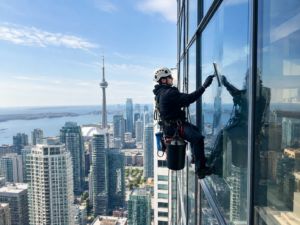
Rope access involves trained technicians descending the building exterior from anchor points on the roof using industrial-grade harnesses, descender systems and a secondary fall arrest line. Technicians work from their harness position, moving across the facade section by section.
Rope access is a widely used method for skyscraper window cleaning in Toronto, allowing professionals to access hard-to-reach areas safely. Using industrial-grade harnesses and descender systems, the team navigates the building’s exterior efficiently while maintaining full control. Springviewwindowcleaning
For Toronto’s downtown tower district, which includes 50-to-80-storey residential condos in dense urban locations with limited ground space, rope access is often the most practical method. It does not require the street-level setup space that swing stages demand. The crew accesses the facade from the roof without a major equipment footprint at ground level and can move around complex facade geometries more freely than a suspended platform. Rope access eliminates the need for cumbersome scaffolding and swing stages. Northern Touch
The credential standard for rope access technicians is IRATA, the International Rope Access Trade Association. All staff members holding IRATA certifications demonstrate a commitment to industry best practices. IRATA operates a three-level certification ladder, with Level 1 being entry-level supervised rope access work and Level 3 being supervisory and rescue-capable. A legitimate high-rise window cleaning crew in Toronto working above four storeys should carry current IRATA certification alongside their Ontario Working at Heights certification. H Breiter Window Cle
Swing Stage
A swing stage, sometimes called a suspended scaffold or swing scaffold, is a platform suspended from the roof by cables on which two or more technicians work while being raised and lowered along the building face. For safe operation, at least two operators are required on the swing stage. Northern Touch
Swing stages are more efficient than rope access for large, flat glass facades where the platform can cover a wider section per descent. Many Toronto downtown towers and commercial office buildings with regular rectangular glass facades use swing stage as their primary exterior cleaning method. The limitation is urban site access: swing stages require clear setup space at ground level and adequate rigging points on the roof, which not every GTA building has available.
Building Maintenance Units and Water-Fed Poles
Building Maintenance Units (BMUs) are permanent mechanical systems integrated into the building design, typically found on modern high-rise towers constructed in Toronto’s recent development boom. The BMU travels along a roof track and can position a gondola or cradle on any section of the building facade. When a building has a functioning BMU, it is the most controlled and safest method of regular exterior maintenance. Not all buildings have BMUs, and those that do require that the cleaning provider has crew trained in their operation.
For buildings up to a certain height, water-fed poles offer an efficient and eco-friendly alternative. These extendable poles use purified water to clean windows without harsh chemicals, leaving a streak-free finish while minimizing environmental impact. Water-fed poles are typically used for mid-rise sections and lower floors where the height is accessible from ground level with an extended pole, rather than for full high-rise exterior work. Springviewwindowcleaning
Ontario Regulations: What Is Non-Negotiable
Before any crew goes above four storeys on a Toronto property, three regulatory requirements are non-negotiable regardless of the building size, the scope of the work or any other factor.
Working at Heights Certification. Every worker performing tasks above 3 metres in Ontario must hold a current Working at Heights training certification approved by the Ontario Ministry of Labour, Immigration, Training and Skills Development. This is not a company-level certification. It is an individual worker certification that must be current at the time of the work. A property manager or condo board that allows uncertified workers to perform elevated exterior work on their building carries shared liability for any incident that occurs.
WSIB Clearance Certificate. Every contractor performing work on a property must provide a current WSIB (Workplace Safety and Insurance Board) clearance certificate confirming the company and its workers are registered and in good standing. Property managers who engage contractors without current WSIB clearance may be held liable for worker injury costs if an incident occurs.
Site-Specific Safety Plan. Beyond the worker certifications, a responsible high-rise window cleaning provider should produce a site-specific hazard assessment and safety plan for each building before work begins. This is not a generic company document. It is a plan that identifies the specific access points, anchor locations, ground exclusion zones, emergency procedures and crew assignments for the specific property being cleaned. High-rise cleaning needs more than certified workers. It needs a building-specific plan. Arellicleaning
Requesting the full safety file — proof of insurance, WSIB clearance, individual worker training records and the site-specific hazard plan — before any price discussions is the professional standard, not an intrusion. Proof of insurance, WSIB clearance, worker training records, and site-specific hazard procedures should be reviewed before price discussions. Arellicleaning
The GTA-Specific Factors That Complicate High-Rise Window Cleaning
Toronto’s built environment creates specific complications for high-rise window cleaning that property managers in other Canadian cities do not face at the same scale.
Wind tunnels in the downtown core. Toronto’s tower district — the concentration of 50-to-80-storey residential condominiums in the downtown core and the emerging Vaughan Metropolitan Centre and North York clusters — creates street-level wind tunnels and elevated building-face wind loads that affect the accessibility windows available for rope access and swing stage operations. Wind conditions above a certain threshold ground rope access and swing stage operations entirely. Property managers should expect that any given booking date carries a possibility of weather-related rescheduling, and scheduling agreements for high-rise work should address this explicitly. Masterbuildingservices
Seasonal accumulation specific to GTA urban conditions. The GTA’s seasonal cycle deposits a year-round accumulation on exterior glass that is more varied and more aggressive than most markets: winter road salt spray on lower-floor windows, spring algae and mineral deposits from snowmelt and rain runoff, summer pollution haze from urban air quality and construction dust, and fall leaf residue and organic matter from deciduous tree canopy near mid-rise buildings. This accumulation profile is why Toronto high-rises benefit from cleaning frequencies higher than once per year, and why lower floors in buildings near major Toronto roads carry a heavier cleaning load than upper floors. Masterbuildingservices
Construction activity. The GTA’s sustained construction activity across the downtown core and the outer municipalities means that high-rise buildings in active construction areas accumulate concrete dust, silica particulate and construction debris on exterior glass at a rate that significantly exceeds normal urban accumulation. Post-construction window cleaning for buildings adjacent to active sites is a specific category of high-rise cleaning that requires a different chemistry approach from standard maintenance cleaning.
Building density and ground access. Downtown Toronto’s tight urban grid means that many high-rise buildings have minimal setback from the sidewalk and adjacent buildings. Establishing a safe ground exclusion zone below rope access or swing stage operations, which is an OHSA requirement, requires coordination with the building, the property manager and in some cases the city regarding sidewalk access.
How Often Toronto High-Rise Buildings Need Window Cleaning
Most commercial and condo buildings clean exterior windows once or twice per year. Buildings exposed to traffic pollution, construction, or coastal weather may require more frequent service to prevent glass staining. TowerCrest
For practical Toronto high-rise scheduling, the industry standard is two exterior cleans per year — spring after winter accumulation and fall before winter. The full guide to how often windows should be professionally cleaned in the GTA covers the frequency variables in detail, including the impact of road proximity, building orientation and facade exposure.
For commercial office towers in the Financial District and Entertainment District, where tenant satisfaction and building presentation standards drive the requirement, quarterly exterior cleaning is not uncommon. For residential condo buildings, twice per year is the standard minimum across the GTA.
Interior common area glass, including lobby glass, corridor windows, elevator doors and amenity space glazing, follows a completely separate and more frequent schedule from the exterior cleaning program. Interior cleaning typically runs quarterly or monthly depending on the building’s standards and is usually part of a broader facility maintenance contract rather than the exterior window cleaning scope.
What a Professional High-Rise Window Cleaning Service Should Deliver
Beyond the physical cleaning of the glass, a professional high-rise window cleaning engagement for a GTA condo building or commercial property should include these components.
A pre-work site inspection and anchor point assessment. Before any cleaning date is confirmed, the provider should inspect the building’s roof anchor points, assess access options and identify any complications such as HVAC equipment blocking access or non-standard anchor configurations. This inspection is what produces the site-specific safety plan discussed above.
Ground exclusion zone coordination. The area at ground level below any rope access or swing stage operation must be cleared and managed to prevent public access during the work. For downtown Toronto buildings adjacent to public sidewalks, this requires coordination with building management and possibly permits from the City of Toronto.
Photo-verified completion documentation. Every visit should generate photo-verified completion documentation. For property managers reporting to condo boards or building owners, photographic evidence of completed work is the professional standard and protects the management company in the event of any dispute about scope or quality. Masterbuildingservices
Condition reporting alongside the cleaning. A professional crew working the exterior of a building is in a position to identify window seal failures, cracked glazing, compromised caulking, facade panel issues and other building envelope concerns that are invisible from inside the building. This reporting function — noting maintenance issues observed during the cleaning visit — is what separates a professional high-rise window cleaning partner from a company that simply cleans glass.
Cost Expectations for High-Rise Window Cleaning in Toronto
High-rise window cleaning pricing is always custom, based on the specific building. Generic per-pane or per-window pricing from residential window cleaning does not translate to high-rise commercial work. The variables that drive high-rise pricing include the number of floors, the facade complexity, the access method required, the anchor infrastructure in place, the ground access conditions and the frequency arrangement.
Hourly rates typically range from $50 to $90 per hour per technician. For mid-rise or rope access jobs in downtown Toronto, companies often provide custom flat-rate estimates due to safety compliance and equipment requirements under Ontario working at heights regulations. TidyUp Handy Crew
For mid-rise buildings between 6 and 15 storeys, GTA property managers typically receive flat-rate quotes covering the full exterior cleaning of the building. For full high-rise towers of 20 or more storeys, most providers scope the project after a site inspection and price it against the specific access method, crew size and time estimate for that building.
The full residential and commercial window cleaning cost guide for the GTA covers 2026 pricing across different building types. For property managers comparing quotes for the same building, the critical comparison is not the headline price but what the scope covers: number of floors, interior versus exterior, frame and track cleaning, and documentation.
Questions to Ask Before Signing a High-Rise Window Cleaning Contract
These questions protect the property manager, the building and the building’s occupants.
Can you provide current WSIB clearance and individual worker Working at Heights certifications before the work date? Not upon request on the day. Before the contract is signed.
Will you provide a site-specific safety plan for this building? A company that offers a generic safety document without visiting the property first does not have a building-specific plan.
What is your wind threshold for stopping work, and how do you communicate rescheduling? The answer should include a specific wind speed limit and a clear communication process.
What access method will you use and why is it right for this building? A professional can explain why rope access, swing stage or BMU is appropriate for the specific building based on the facade design and roof infrastructure.
What documentation do you provide upon completion? Photo evidence, scope confirmation and any condition observations noted during the work.
Working with My Property Care for Window Cleaning Across Toronto and the GTA
My Property Care provides professional window cleaning for residential and commercial properties across Toronto and the GTA, serving homeowners, landlords and property managers with transparent scope and confirmed scheduling. For property managers specifically managing window cleaning programs across multiple properties or overseeing the specific service and documentation requirements for condo boards and building owners, the guide to window cleaning for property managers and condo corporations covers the service model built around how property management actually works.
Understanding why GTA windows need specific attention after each season is covered in the spring window cleaning guide for GTA properties. For building managers who have not had an exterior clean in two or more seasons, the DIY vs. professional window cleaning guide covers the specific consequences of deferred cleaning including mineral deposit etching that cannot be reversed after 12 to 18 months of exposure.
Call 289-301-0925 or fill in the quote form to discuss your building’s specific requirements and get a clear, scoped estimate before any work begins.
Published: September 2026 | My Property Care serves Toronto, Mississauga, Markham, Etobicoke, Vaughan, Thornhill, Richmond Hill, North York, Scarborough, Brampton and Oakville.