
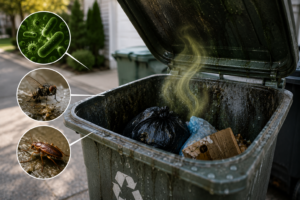
You watched the truck come. You watched it lift your bin. You heard everything tip out. You brought it back in and opened the lid to confirm it was empty, and the smell nearly knocked you sideways.
The bin is empty. The smell is not gone. This is not your imagination and it is not a fluke. It happens to virtually every GTA homeowner who has not had their bin professionally cleaned, and the reason it happens explains exactly why household cleaning methods do not resolve it.
The Reason Your Empty Bin Still Smells
The answer is a single word that explains everything: biofilm.
Every time a bag of garbage goes into a bin, microscopic amounts of food residue, liquid, grease and bacteria coat the interior walls. The bag is not a perfect seal. Juices and particles escape from the bottom and sides of every bag placed in the bin and make contact with the plastic surface. Over weeks and months, bacteria multiply and form a slimy, sticky layer called biofilm, the same thing that forms inside a dirty pipe or on unbrushed teeth.
Biofilm is not ordinary surface contamination. It is a structured colony where bacteria have built physical scaffolding to protect themselves. The bacteria secrete a polysaccharide matrix, essentially a protective coating that physically shields the colony from cleaning attempts. Once a biofilm establishes inside a bin, normal cleaning barely touches it. You can rinse the bin with a garden hose, watch the water run brown, and still leave 80 percent of the bacterial mass intact.
That is why the bin smells after it has been emptied. The garbage is gone. The biofilm colony is not. It remains on the interior walls, the base of the bin and the underside of the lid, producing the gases that carry the smell regardless of whether there is current waste inside.
Three signs your bin has crossed into biofilm territory:
The base feels slippery even when it looks empty. That is the polysaccharide matrix the bacteria secrete.
The smell returns within a day or two of taking the trash out.
You can see a dark or sticky residue on the interior walls or base even after rinsing.
What Is Actually Growing Inside Your Bin
Most homeowners assume a smelly bin is an unpleasant hygiene problem but not a health risk. The specific bacteria found in residential bins tell a different story.
Even when your bin is emptied, small bits of food, liquid and grease often remain stuck to the sides and bottom. Over time, these remnants decompose and harbour bacteria like Salmonella, E. coli, and Listeria, causing foul odours to persist. Ocpartnership
- coli. Research published in PMC in 2024 confirmed that E. coli colonizes plastic surfaces within 24 hours and persists within biofilm structures for days to weeks. The common strains are harmless. E. coli O157:H7, found in meat and poultry packaging waste, can cause bloody diarrhea, severe abdominal cramps and vomiting. In young children, it can progress to haemolytic uremic syndrome, a potentially life-threatening condition involving kidney failure.
Salmonella. The CDC attributes about 1.35 million Salmonella infections annually in the United States. In Canada, the Public Health Agency estimates that nontyphoidal Salmonella is responsible for approximately 87,510 food-related illnesses, 925 hospitalizations and 17 deaths per year. Scientific studies indicate that Salmonella can survive for weeks in a trash can environment.
Listeria. Particularly dangerous for pregnant women, elderly residents and anyone immunocompromised. Listeria thrives in cool, damp conditions for up to four weeks, meaning it does not require summer heat to persist.
Staphylococcus. Can cause skin infections and respiratory complications when transferred from a contaminated bin surface to a household setting.
Dirty bins can harbour bacteria such as Salmonella, E. coli, and Listeria, which are known to cause gastroenteritis, food poisoning, and respiratory infections. The point is not to generate panic about a bin. It is to explain why the smell coming from the biofilm colony inside your bin is a practical health signal rather than just an unpleasant annoyance.
The GTA-Specific Factors That Make This Worse
Toronto and the GTA have two conditions that accelerate the bin hygiene problem beyond what milder climates experience.
Summer heat. In summer, bins left outside in the heat can begin to smell within hours, even if they were just emptied the day before. July and August temperatures across the GTA create ideal bacterial growth conditions. Bacteria can double in number every twenty minutes under these conditions. A bin that smelled manageable on Monday collection morning can become genuinely foul by Wednesday afternoon.
The Green Bin and organic waste programs. York Region municipalities including Markham, Thornhill and Vaughan operate the Green Bin organics collection program. Peel Region including Mississauga and Brampton runs a similar program. The City of Toronto collects organic waste separately from regular garbage. Between collections, organic material containing food scraps, meat packaging, coffee grounds and vegetable matter sits inside green bins in summer heat, creating concentrated bacterial conditions that a standard garbage bin, carrying bagged waste only, does not.
For GTA homeowners using the Green Bin program, this bin needs regular professional cleaning at least as urgently as the regular garbage bin.
Toronto raccoons. The smell of food coming from human garbage, compost, and recycling is irresistible to raccoons. Toronto has one of the highest urban raccoon densities of any city in North America. An uncleaned bin with established bacterial odour does not just attract flies. It draws raccoons reliably, which is why a bin that smells strongly becomes a target for tipping, scratching and persistent wildlife interaction throughout the summer. Eliminating the odour at its bacterial source removes the olfactory signal that raccoons are responding to.
Why Household Cleaning Methods Do Not Fix the Problem
This is where the frustration most GTA homeowners feel about their bins comes from. They clean the bin, they use cleaning products, the smell goes away briefly and it comes back within days.
The reason is biofilm resistance. Once a biofilm establishes, normal cleaning barely touches it. You can rinse the bin with a hose, watch the water run brown, and still leave 80 percent of the bacterial mass intact.
A garden hose rinse dilutes and displaces surface liquid but does not penetrate the polysaccharide matrix protecting the bacterial colony on the bin walls. Standard household cleaners applied at household dilutions can damage the outer edges of a biofilm colony but leave the inner layers intact, and the colony re-establishes to full density within days.
Bleach is more effective than standard cleaners but has specific limitations in bin application. Applied to an established biofilm on a bin surface, bleach penetrates the outer layer and disrupts the colony partially. The interior layers of the colony, shielded by the polysaccharide matrix, survive. The smell returns because the surviving bacteria resume producing the gases that cause the odour. Additionally, bleach residue inside a bin can damage the plastic over time and may react with organic material in subsequent waste.
Deodorising sprays and scented bin liners mask the smell temporarily. They do not interact with biofilm chemistry at all. The odour returns because the masking agent fades while the colony remains.
The Transfer Risk Most People Do Not Think About
The health concern from bin bacteria is not only from direct contact with the bin interior. The contamination routes that concern me most are not the obvious ones. It is not the smell or the visible grime. It is the bin handle that a child grabs on the way to the car, or the lid that someone touches before grabbing a sandwich. Those are the moments when E. coli moves from the bin to the kitchen without anyone noticing.
- coli colonies can survive 48 hours on plastic handles. Every time a household member touches the bin lid, the handle or the side of the bin while rolling it to the kerb or bringing it back in, they are making contact with a contaminated surface. The typical sequence that follows, touching the car door, touching a child, preparing food, handling kitchen items, is the transfer route that moves bacteria from the bin into the household environment.
Dirty bins release odour molecules and airborne bacteria that travel into adjacent spaces, including garages and entryways. Families with asthma or allergies are especially vulnerable to this effect.
For households where the bin is stored adjacent to the garage, in a side passage near the back door or in any area with proximity to indoor spaces, this airborne transfer dimension adds a practical hygiene argument to the existing odour problem.
What Professional Bin Cleaning Does That Household Cleaning Cannot
The difference between a garden hose rinse and professional bin cleaning is not effort or thoroughness. It is temperature, pressure and chemistry.
Hot water at high temperature kills bacteria by denaturing the proteins that bacteria use to function. At temperatures above 60°C, bacteria including the biofilm-protected colonies inside residential bins are eliminated at contact. A garden hose delivers water at ambient temperature, which does not reach the threshold required for bacterial kill regardless of how long the rinse continues.
High-pressure water delivery combined with that temperature reaches the biofilm colony physically, breaking down the polysaccharide matrix before the heat eliminates the bacteria within it. This is the physical reason why professional bin cleaning produces results that household methods cannot replicate.
Following the hot water extraction, a hospital-grade sanitising solution is applied to the cleaned interior surfaces. This addresses any remaining bacterial load and prevents rapid re-colonisation of the now-clean bin surface.
The process also properly contains and disposes of the waste water generated during the clean, which carries the bacteria and residue extracted from the bin. This water cannot go to a standard drain without treatment, and responsible professional cleaning handles disposal correctly.
How Often Should GTA Bins Be Professionally Cleaned
Monthly cleaning through summer and bi-monthly through cooler months is the professional standard for residential bins in Toronto and the GTA. July and August are the most critical months given the temperature conditions. Green Bin users should treat their organic bin as a priority on the same schedule.
The rationale is straightforward: the biofilm cycle that creates the smell problem takes several weeks to re-establish after a proper professional clean. Monthly cleaning interrupts that cycle before it produces the conditions that generate odour, attract wildlife and create the bacterial load described above.
My Property Care provides professional garbage bin cleaning and sanitization across Toronto and the GTA, covering garbage bins, recycling bins and Green Bins using hot water under pressure followed by hospital-grade sanitising treatment. Service runs automatically after each collection day on a recurring schedule so it happens without requiring a separate booking each time.
For households where professional-grade sanitization of the bin area or adjacent spaces is also needed, disinfection and sanitization services are available for the full range of residential and commercial applications.
Call 289-301-0925 or fill in the quote form to set up recurring bin cleaning for the coming summer months.