
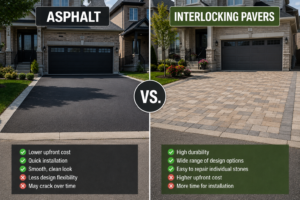
The driveway decision looks different in the GTA than it does almost anywhere else in Canada. Toronto’s freeze-thaw cycle, specifically the repeated movement of ground temperatures above and below zero across October through April, is one of the most demanding conditions a paved surface can face. Whatever material you choose has to handle that cycle reliably for the length of time you plan to own the home.
This comparison gives you the honest numbers on both options, explains why freeze-thaw behaviour should anchor the decision for most GTA homeowners, and tells you clearly which option makes more sense based on your situation, not the one that sounds best in a sales pitch.
The Quick Comparison
| Factor | Asphalt | Interlocking Pavers |
| Cost per square foot (installed) | $3 to $7 | $18 to $40 |
| 600 sq ft driveway installed | $2,800 to $4,200 | $10,800 to $24,000 |
| Lifespan in GTA climate | 8 to 15 years | 25 to 30 years |
| Resealing required | Every 3 to 5 years | Optional every 2 to 3 years |
| Freeze-thaw performance | Moderate | Excellent |
| Repairability | Full section or resurface | Individual paver replacement |
| Curb appeal | Standard | High |
| Resale impact | Minimal | Meaningful in premium markets |
What Asphalt Actually Delivers for a Toronto Driveway
Asphalt remains one of the most practical and cost-effective choices for residential driveways in the GTA. It installs quickly, handles cold weather with reasonable flexibility and gives a clean, traditional finish.
The material itself has some natural freeze-thaw tolerance because it is a flexible surface rather than a rigid one. Unlike concrete, which expands and contracts as a monolithic slab under temperature changes, asphalt can absorb some of the ground movement that Toronto winters produce. This is one reason asphalt was the standard choice for GTA residential driveways for decades.
Asphalt offers strong freeze-thaw resistance when installed with the correct granular base and compacted sub-grade. The emphasis on correct base preparation is not incidental. An asphalt driveway installed over inadequate base preparation in Ontario’s freeze-thaw climate will begin showing the consequences within two to five years, regardless of the asphalt quality itself. The base determines the performance.
Asphalt’s practical realities for GTA homeowners:
Asphalt driveways in Ontario need resealing every three to five years. Over 20 years, that adds up in both cost and disruption. Eventually, asphalt also needs resurfacing or full replacement as the surface degrades, cracks, and softens under summer heat and winter frost.
Road salt is asphalt’s primary enemy in the GTA. The salt used on Toronto’s roads through November to March penetrates the asphalt surface, weakens the binder that holds the aggregate together, and accelerates both cracking and surface spalling. An asphalt driveway close to a salted road carries more maintenance demand than one at the end of a quiet residential street for exactly this reason.
The other material limitation specific to Toronto summers is heat softening. Asphalt softens in direct sunlight at summer temperatures, and vehicles parked in the same position repeatedly through July and August can leave visible marks in the surface over time. South-facing driveways with full afternoon sun exposure experience this more noticeably than shaded driveways.
Who asphalt makes sense for: Homeowners on a tight budget, those planning to sell within five to seven years, and properties where the driveway is straightforwardly functional rather than a curb appeal priority. Tightest budget, selling within five to seven years: asphalt. Lowest day-one cost, and you will not be around for the reseal and resurface cycle.
What Interlocking Pavers Actually Deliver for a Toronto Driveway
Interlocking pavers are the premium option for GTA driveways, with upfront costs that are two to three times higher than asphalt and long-term performance characteristics that justify that premium in the right circumstances.
The fundamental engineering advantage of interlocking over both asphalt and concrete for the GTA climate is the joint system. Interlocking pavers are designed to move with the ground. When the ground freezes and expands, or thaws and softens, individual pavers shift slightly without cracking, whereas a concrete slab would fracture under the same conditions. The joints between units are the flex points, which is exactly why pavers ride out clay movement that cracks rigid surfaces.
This is not a minor technical point. It is the defining performance difference for Ontario’s climate specifically. Concrete and asphalt rely on rigidity or semi-flexibility to handle ground movement. Interlocking accommodates that movement by design. A properly installed interlock driveway in the GTA does not crack because it is not a surface that cracks. Individual pavers may shift, and those can be relevelled or replaced individually without disturbing the rest of the surface.
The repair economics of interlocking are genuinely different:
When a section of asphalt cracks or a concrete driveway develops a fault line, the repair options are patch and resurface (which is visible and impermanent) or full section replacement. The stamping pattern fades, the integral colour weathers, and any crack repair is permanently visible because you cannot replace a single stamped panel without a colour mismatch. Interlocking holds up dramatically better through the Ontario freeze-thaw cycle, and individual repairs are essentially invisible.
A shifted or damaged interlock paver is lifted, the base beneath adjusted if needed, and the stone relaid. The repair is invisible because the stone itself matches the surrounding surface exactly. This is not cosmetically superior to asphalt as a preference. It is structurally different as a maintenance model.
Lifespan in real GTA conditions:
Interlocking pavers: 25 to 30 years. Concrete: 10 to 15 years. Asphalt: 8 to 12 years. These figures assume professional installation over a properly prepared base. The lifespan numbers are not theoretical. They reflect what these surfaces actually deliver under Ontario’s freeze-thaw and salt exposure conditions when installed correctly.
Who interlocking makes sense for: Homeowners in their long-term property, buyers in areas where premium presentation matters for resale value, properties in Markham, Thornhill, Vaughan and Oakville where interlock is the neighbourhood standard for well-maintained homes, and anyone whose driveway is visible from the street and contributes meaningfully to the home’s first impression. Forever home, 15-plus year horizon: interlock. Longest life, invisible repairs, no fading, best resale.
The GTA Freeze-Thaw Factor That Changes the Calculus
Toronto experiences a specific climate condition that makes the driveway material decision more consequential than it would be in a milder Canadian city.
The freeze-thaw cycle refers to the repeated pattern of temperatures dropping below zero overnight and rising above zero during the day, which occurs dozens of times across a typical GTA winter. Each freeze-thaw event expands and then contracts the ground and any moisture within the driveway base and surface material. For rigid surfaces like concrete, this cycling is what creates the cracks that appear within seven to fifteen years of installation. For asphalt, it accelerates the surface deterioration that makes resealing a recurring requirement rather than an optional refinement.
Interlock handles freeze-thaw cycles better. The joints between pavers allow natural ground movement. Stones shift slightly instead of cracking like a solid surface. Asphalt is more rigid. It resists movement, which leads to cracking over time.
For GTA homeowners specifically, this means the freeze-thaw performance of whichever surface you choose is not a minor consideration. It is the primary durability variable, and it operates every winter across the life of the driveway.
The Cost-Per-Year Reframe That Changes the Comparison
The headline cost difference between asphalt and interlocking, roughly $3 to $7 per square foot versus $18 to $40 per square foot, is the number most GTA homeowners use to make the decision. It is not the most accurate number to base the decision on.
Interlocking costs more upfront than asphalt. That is true. But over a 20-year window, interlocking typically costs less to own than asphalt when repairs are factored in. Short-term owners and very tight budgets are exceptions.
The calculation works like this. An asphalt driveway at $4,000 installed requires resealing every three to five years at a cost of roughly $300 to $600 per application, and resurfacing or replacement within 10 to 15 years depending on the original installation quality and winter exposure. The 20-year cost of ownership on an asphalt driveway, including maintenance and eventual replacement, is not $4,000. It is considerably more when the full cycle is counted.
An interlocking driveway at $15,000 installed requires polymeric sand replacement every five to eight years and optional sealing every two to three years, with the actual surface material lasting 25 to 30 years before the installation itself needs replacement. The per-year cost of ownership over that period, divided into the installation and maintenance total, is often comparable to or lower than asphalt’s per-year cost over its shorter lifespan.
When you spread the cost across the full lifespan, interlocking often comes out even or ahead. Whichever material you choose, a handful of factors move your quote: size, tearing out the old driveway, site and access, drainage and materials.
The Low Quote Warning That Applies to Both Materials
Whether you are pricing asphalt or interlocking, one warning applies consistently and importantly across the GTA paving market.
The base depth is the one to pay attention to. In Southern Ontario’s freeze-thaw climate, a driveway needs a properly compacted granular base, typically 10 to 12 inches for vehicle traffic. This is exactly where lowball quotes cut corners, because you cannot see the base once the pavers are down. A thin base looks identical on day one and heaves by year three.
For interlocking specifically: The number to walk away from is anything well below $20 per square foot installed. At that price, base prep is being skipped.
For asphalt: an unusually low quote for a full driveway usually reflects either a thin lift of asphalt over minimal base material, or inadequate compaction of whatever base was laid. The result is visible within two to three winters as cracking begins from below rather than at the surface.
The base preparation is the single most important factor in the long-term performance of any GTA driveway, and it is invisible once the surface material is down. Any company quoting a driveway installation should be able to describe in specific terms how deep they are excavating, what base material they are using and how they are compacting it. If these details are not part of the quote conversation, they are likely not part of the job.
The Decision in Plain Terms
Choose asphalt if: Your budget is the primary constraint, you are planning to sell within the next seven years, or the driveway is a functional surface rather than a curb appeal feature for your property.
Choose interlocking if: You are in the property for the long term, the driveway is visible from the street and contributes to the home’s presentation, your neighbourhood in Markham, Thornhill, Vaughan, Oakville or Forest Hill features interlocking as the standard for well-maintained homes, or you want the surface that performs best under Ontario’s freeze-thaw conditions over a full 25 to 30 year period.
My Property Care provides driveway paving and interlock services across Toronto and the GTA, covering asphalt installation, interlocking paver installation and repair, and assessment of existing driveways that need resurfacing or full replacement. Every project starts with a no-obligation quote that covers the full scope including base preparation, material selection and drainage, so the number you are given reflects the complete job rather than the headline figure.
Call 289-301-0925 or fill in the quote form for a free assessment of your specific driveway.
Published: July 2026 | My Property Care serves Toronto, Mississauga, Markham, Etobicoke, Vaughan, Thornhill, Richmond Hill, North York, Scarborough, Brampton and Oakville.