
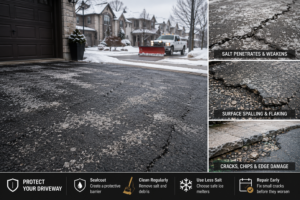
Every winter, Ontario municipalities spread enormous volumes of road salt across highways, arterials and residential streets across the GTA. Some of that salt stays on the roads. A significant amount of it ends up on your driveway, tracked in by vehicle tyres and foot traffic, splashed from passing cars and blown from nearby road surfaces. By the time March arrives, your driveway has absorbed months of chloride exposure that it will spend the rest of the year quietly converting into surface deterioration.
Most GTA homeowners know road salt is bad for driveways in a vague sense. Few understand the specific chemistry behind what it actually does, why the GTA’s particular winter conditions make it especially damaging, or what the protective steps are that genuinely work versus the ones that sound useful but arrive too late.
What Road Salt Actually Does to a Driveway
The damage mechanism is different for concrete and asphalt, and understanding the difference matters for choosing the right protective approach.
What Happens to Concrete
Concrete is a porous material. It absorbs water through its surface under normal conditions. During winter, when that water contains dissolved salt from road de-icing, the absorption continues with the chloride ions riding along with the moisture.
The damage process works in two ways simultaneously.
The first is physical. Salt lowers the freezing point of water, which sounds like a benefit for melting ice. In a driveway context, it means more frequent freeze-thaw cycles occur within the concrete’s pores than would otherwise happen naturally. Each time water inside the concrete freezes, it expands by approximately 9 percent. That expansion creates internal pressure that exceeds the tensile strength of the concrete surface layer, causing it to pop off in fragments. This is spalling, and it is the most visible sign of advanced salt damage on concrete driveways across the GTA.
The second is chemical. Chloride ions from the salt penetrate the concrete matrix and react with the calcium hydroxide in the cement paste, breaking down the binding compound that holds the aggregate together. When the binding compound degrades, the concrete loses structural integrity from the inside. The surface begins scaling, meaning it peels and flakes in thin layers that look similar to paint failure. On reinforced concrete, the chloride ions also corrode the steel reinforcement bars inside the slab, which expands as it rusts and causes cracking from within.
What Happens to Asphalt
Asphalt damage from road salt operates through a different primary mechanism. Salt does not directly dissolve asphalt, but the freeze-thaw cycles it accelerates do. Salt lowers the freezing point of water, causing more frequent freeze-thaw cycles during winter temperature fluctuations. Each freeze-thaw event that occurs within asphalt’s pores expands and contracts the material, gradually widening cracks.
Salt also attracts and holds moisture against the asphalt surface, keeping it wetter for longer periods than it would be after a salt-free snowfall. This extended moisture exposure compounds the freeze-thaw damage. The chloride salts from road de-icing also dry out the bitumen binder that holds asphalt aggregate together. A sealed driveway in Etobicoke or Scarborough will outlast an identical unsealed one by five to eight years under real GTA conditions because the sealer slows this binder degradation.
What Happens to Interlock
Interlocking pavers are structurally more resistant to salt damage than concrete or asphalt because individual pavers can flex with freeze-thaw movement rather than cracking as a monolithic surface. The primary salt damage risk for interlock comes through the joints. Salt water that penetrates the joints can degrade the polymeric sand that locks the joint, which allows water to reach the granular base beneath. Once the base becomes saturated, the freeze-thaw cycle works on that base material, producing the heaving and settlement that is one of the most common interlock failure modes across the GTA.
Why the GTA Is Especially Hard on Driveways
Toronto averages more than 30 freeze-thaw cycles per winter. That number is the critical context for understanding why driveway salt damage accumulates faster in the GTA than in cities with colder but more consistent winters.
A city that stays consistently below zero through winter does not experience the same pore-expansion and contraction cycle that the GTA’s fluctuating temperatures produce. Toronto’s winters routinely swing above and below zero multiple times per week through December, January and February, and the periods of above-freezing temperature allow salt to remain active and mobile within the surface material rather than being frozen in place.
Properties near major road corridors carry additional exposure. The 401, the QEW, the Gardiner Expressway, the DVP, the 427 and the 404 are among the most heavily salted roads in Ontario. Vehicle spray from these highways and the arterials feeding them deposits chloride on driveways several properties back from the road edge. A homeowner on a residential street that backs onto a salted arterial carries more salt exposure on their driveway than a homeowner on a quiet cul-de-sac, even if neither uses salt themselves.
The frost line in Toronto sits at approximately 1.2 metres. A poorly installed or aging driveway with an inadequate base allows water and salt to reach the frost zone below the surface, where freeze-thaw cycling works on the base material rather than just the surface. This is the failure mode that produces heaving and uneven settlement in driveways that appear cosmetically intact but have base compromise beneath them.
The Signs of Salt Damage: What to Look For
These signs appear progressively. Catching them at the early stages allows protective action before structural damage sets in.
Efflorescence. The white or chalky residue appearing across concrete and interlock surfaces each spring is mineral salt being deposited on the surface as water evaporates. It is the most visible and earliest indicator of salt reaching and moving through the surface material. Efflorescence itself is removable. The underlying salts that produce it are already inside the material.
Surface scaling. The top layer of concrete separates in thin, flat fragments that look like peeling paint or flaking stone. This is the early stage of spalling and indicates the freeze-thaw cycle has been working on the surface for at least one to two winters with salt exposure. Scaling that covers less than 25 percent of the surface can be treated with penetrating sealers and crack fillers. Scaling across more than 30 percent of the driveway area indicates replacement is more cost-effective than continued surface repair.
Pitting and spalling. Small holes, larger cavities and sections of surface that have broken away in chunks. This is salt damage that has been present for multiple seasons without protective intervention. The cement paste binding the aggregate has degraded enough that the surface material is releasing under normal traffic and weather stress.
Grey, oxidised asphalt. Fresh asphalt is deep black. As it ages and its binder degrades under salt and UV exposure, it turns grey. Grey asphalt is brittle and has lost the flexibility that makes asphalt function in freeze-thaw conditions. It cracks more readily and absorbs more water per event than sealed, maintained asphalt.
Crumbling edges. Edge deterioration often appears before surface damage because the edges of a driveway receive less traffic compaction and more direct exposure to salt spray from the road. Once edges begin crumbling, the perimeter becomes vulnerable to accelerating damage inward.
Heaving or uneven settlement. Sections of the driveway that have risen or sunk relative to the surrounding surface. This is base material damage rather than surface damage, and it indicates salt and water have reached and compromised the granular base beneath the paved surface. Surface repair alone does not address base compromise.
How to Actually Protect Your GTA Driveway
Before Winter: The Most Important Window
Seal the driveway before the first freeze. This is the step that delivers the most protection per dollar of any driveway maintenance investment, and it is almost always done too late by homeowners who think about it in November.
For concrete, apply a penetrating silane or siloxane sealer that chemically bonds with the concrete substrate and creates a water-repellent barrier against chloride penetration. These sealers work by filling the concrete’s pores at the surface level, reducing the volume of salt water that can enter the material. Apply every two to three years, on a clean and completely dry surface.
For asphalt, apply a coal-tar emulsion or asphalt-based sealer with polymer additives for the best balance of durability, UV resistance and salt tolerance. The sealer restores the surface binder layer that salt and UV degrade and reduces porosity significantly. Reseal every two to three years, in the optimal temperature window of late spring through early fall when overnight temperatures are reliably above 10°C.
Fill any existing cracks before winter arrives. Even hairline cracks allow salt water direct access to the base material below. For asphalt, use a rubberised elastomeric crack filler that remains flexible at Toronto’s winter temperatures. Generic fillers formulated for milder U.S. climates often fail in the GTA within 18 months.
During Winter: Managing Salt Exposure
On your own walkways and private driveway surfaces, consider alternatives to sodium chloride. Calcium magnesium acetate and calcium chloride are both less chemically aggressive to concrete surfaces while remaining effective at lower temperatures. The City of Toronto’s winter road maintenance program has progressively shifted toward CMA blends for exactly this reason.
When snow clearance occurs after a storm, removing snow promptly reduces the contact time between de-iced slush and the driveway surface. The longer salt-saturated water sits in contact with your driveway, the deeper the chloride penetration.
Redirect downspouts away from the driveway edge. Concentrated downspout discharge pooling at the driveway edge through winter freeze-thaw is one of the primary causes of accelerated Toronto driveway deterioration. A simple extender directing flow to a vegetated area significantly reduces the volume of salt-laden water concentrated at the most vulnerable part of the surface.
After Winter: The Spring Recovery Window
Spring is when the accumulated damage from the past winter becomes most visible and when the most effective protective response is possible before summer UV exposure bonds the remaining residue permanently.
Washing salt residue off the driveway with a hose when temperatures consistently remain above 5°C removes the surface salt concentration before it continues working on the material through spring. Professional pressure washing removes the deeper mineral deposits that a garden hose cannot shift. The signs that your driveway needs professional pressure washing guide covers what specifically to look for after winter.
After cleaning, spring is the right window to fill any cracks that have opened or widened through the winter before the next freeze-thaw cycle works on them further. Spring is the ideal time to assess salt damage from the previous winter and take corrective action. Cracks that opened during winter should be filled before they widen further.
When Salt Damage Has Gone Too Far
The 25 to 30 percent threshold determines whether repair remains cost-effective or replacement delivers better value. If more than 25 to 30 percent of the surface is in poor shape, the long-term cost of continuing to repair it exceeds the cost of replacement.
For driveways showing spalling across most of the surface, significant base heaving or structural cracking that has allowed salt water to reach and compromise the base material, full replacement is the honest recommendation. Continued surface patching on a base-compromised driveway produces repairs that fail on the same timeline as the original problem.
When replacing a concrete driveway showing repeated salt damage, many GTA homeowners upgrade to interlocking at this point specifically because of interlocking’s superior freeze-thaw performance. Understanding which material makes sense for your situation, timeline and budget is covered in the full asphalt vs. interlocking comparison guide and the GTA driveway paving cost guide.
My Property Care provides driveway assessment, paving and interlock services across Toronto and the GTA for driveways that have reached the point where an honest assessment is needed before committing to either repair or full replacement. Every assessment is free and without obligation.
Call 289-301-0925 or fill in the quote form to arrange an assessment for your specific driveway this season.
Best published: Late October or early November as homeowners assess driveway condition before winter, and again in late March as spring reveals the accumulated winter damage. | My Property Care serves Toronto, Mississauga, Markham, Etobicoke, Vaughan, Thornhill, Richmond Hill, North York, Scarborough, Brampton and Oakville.