There is a conversation that happens dozens of times every spring across Toronto and the GTA. A homeowner notices dark streaks running down their roof, assumes it is dirt or mold, calls a pressure washing company, and either gets their roof cleaned in a way that voids the manufacturer warranty and removes years of protective shingle granules, or gets told the right answer — which is that those streaks are not dirt and cannot be pressure washed off safely.
The dark streaking on asphalt shingle roofs is one of the most commonly misidentified and most commonly mistreated exterior maintenance problems in the GTA. This article explains exactly what it is, why Toronto and GTA homes are particularly vulnerable to it, what the only safe and effective cleaning method is, what it costs in 2026, and how to prevent it from returning after treatment.
What Is Actually on Your Roof
Those black or dark greenish-black streaks running down Toronto roofs are not dirt. They are not mold. They are not a sign of failing shingles.
They are colonies of a cyanobacterium called Gloeocapsa magma. This organism feeds on the crushed limestone filler used in asphalt shingle manufacturing and produces a dark pigment as a UV protection mechanism. The dark colour you see is essentially the organism’s sunscreen. It spreads by wind-borne spores, which is why once one roof in a neighbourhood shows streaking, surrounding roofs tend to follow within a season or two. It shows up first on north-facing and shaded slopes where moisture persists longer and direct sunlight is reduced, because Gloeocapsa magma thrives in humid, lower-light conditions.
Beyond the cosmetic damage, the organism traps heat and moisture against the shingle surface. Dark stains and organic growth trap heat and raise attic temperatures. The trapped moisture accelerates the degradation of the asphalt binder that holds shingle granules in place, shortening the functional lifespan of the roof progressively over seasons of untreated growth.
The Difference Between Algae, Moss and Lichen
These three problems look similar from the ground but behave very differently and require different treatment approaches.
Gloeocapsa magma (algae streaking) is the most common. It appears as dark streaks or patches and sits on the surface of the shingle. It is biological and responds to the correct cleaning chemistry, but it does not physically penetrate the shingle structure in the way moss does.
Moss is a more serious problem for shingle integrity. Moss grows between and under shingle tabs, and it does so physically rather than just coating the surface. Moss rhizoids penetrate under shingle tabs, lifting them from the roof surface and breaking the adhesive seal that holds each shingle in place. Once shingle tabs are lifted, wind can catch them and tear them off entirely, rain can drive directly under the lifted edge, and freeze-thaw cycling in Toronto winter causes the trapped moisture to expand and contract, progressively destroying the shingle from underneath. Moss growth is most aggressive on north-facing roof slopes, shaded areas under tree canopy, and sections near the eaves where moisture accumulates and evaporation is slowest. For GTA homes under significant tree canopy in Forest Hill, Thornhill, Leaside and Rosedale, moss is a specific concern that homeowners need to address actively rather than periodically.
Lichen is the hardest to remove and the most damaging long-term. Lichen bonds to the shingle surface chemically, embedding itself into the granule layer. Unlike algae which sits on the surface, lichen cannot simply be washed away. It requires dwell time with the appropriate cleaning chemistry to release the bond before it can be safely rinsed, and severe lichen colonisation may require multiple treatment cycles.
Why Pressure Washing Is Never the Answer for Asphalt Shingles
This is the piece of information that most GTA homeowners learn too late, often after the damage has already been done.
Asphalt shingles have a protective granule coating, the small stone-like particles embedded in the top surface of each shingle. These granules serve two critical functions: they protect the asphalt layer beneath from UV degradation, and they provide the fire resistance and weather resistance that shingles are designed and rated for. Once granules are stripped from the shingle surface, the underlying asphalt is directly exposed to UV radiation and weathering. It breaks down rapidly, the shingle becomes brittle, water shedding is compromised, and the roof ages years faster than its design lifespan.
Your 25-year warranty becomes worthless after one pressure washing. Always check your warranty terms before allowing anyone on your roof with a pressure washer. This is not a minor advisory note. Major shingle manufacturers including GAF, CertainTeed and Owens Corning all specify in their warranty terms that high-pressure washing of asphalt shingles is not an approved maintenance method and may void coverage. The Asphalt Roofing Manufacturers Association, the governing body for the North American asphalt roofing industry, recommends against pressure washing for the same reason.
A pressure washer operating at 3,000 PSI aimed at a roof surface does not know the difference between the algae colony on the surface and the granule coating beneath it. It strips both. The roof looks clean immediately after. The damage is invisible on the day and only becomes apparent over the following one to two winters as the exposed asphalt sections begin cracking and the roof ages past its expected service life years ahead of schedule.
For a complete explanation of why this method distinction matters across all exterior surfaces, the pressure washing versus soft washing guide covers the specific technical reasons each method is appropriate for different materials, including the specific roof warranty language from major manufacturers.
What Soft Washing Is and Why It Works
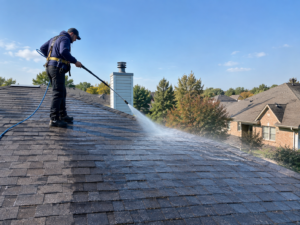
Soft washing is the industry-approved method for cleaning asphalt shingle roofs. Unlike high-pressure washing, which can strip away protective granules from shingles, soft washing gently cleans and removes algae, moss, and grime without damage.
The process works at 100 to 200 PSI, which is roughly equivalent to a garden hose. The cleaning power comes from chemistry rather than pressure. A diluted sodium hypochlorite solution combined with surfactants and, where appropriate, biocide additives is applied at low pressure to the roof surface. This solution kills the Gloeocapsa magma organism and disrupts moss and lichen colonies at a biological level rather than simply displacing them from the surface.
This is the critical distinction that determines how long the results last. Pressure washing on a surface that allows it, like a concrete driveway, physically removes the visible contamination but leaves any root system or biological material below the surface intact. The organism regrows from the surviving base within weeks to months. Soft washing kills the organism. Results last 2 to 4 years on a treated roof because there is no surviving colony to regrow from. The existing staining fades over the weeks following treatment as the dead organisms are rinsed away naturally by rainfall.
The soft wash solution is applied by a trained technician who manages the product dilution, dwell time and rinsing sequence appropriate for the specific contamination type on the specific roof. Algae streaking responds faster than moss. Lichen requires the longest dwell time and may need a second application for severe colonisation.
Why Toronto and GTA Homes Are Particularly Vulnerable
Several factors specific to Toronto and the GTA create roof cleaning conditions that are more demanding than many other Canadian cities.
Lake Ontario humidity. The moderating effect of Lake Ontario on Toronto’s climate, while beneficial for temperature stability, adds consistent atmospheric moisture. Humidity is what Gloeocapsa magma and moss require to establish and spread. Toronto summers are warmer and more humid than cities further inland, creating the exact environmental conditions that biological roof growth favours.
Dense tree canopy in established GTA neighbourhoods. The mature residential tree coverage across Forest Hill, Rosedale, Lawrence Park, Leaside, Thornhill and established Mississauga and Markham neighbourhoods creates shaded, damp roof conditions that accelerate biological growth on north-facing slopes. Shade keeps roof sections damp longer, especially north-facing slopes. A home with significant tree canopy over the roof in these GTA neighbourhoods will see moss and algae develop faster and more aggressively than an equivalent home on an open street with full sun exposure.
Toronto’s seasonal cycle. Spring rain and warming temperatures after a Toronto winter create the warm, wet conditions that prompt algae and moss spores to germinate and establish on shingle surfaces. Summer heat then bakes the established growth into the shingle surface, making it progressively harder to remove with each season it is left untreated. Fall brings leaf debris that sits on roof sections and holds moisture against the shingles through winter. The season-by-season accumulation specific to a Toronto climate means roofs that are not treated every 2 to 4 years develop significantly heavier contamination than the same roofs in a dryer climate would.
The winter freeze-thaw problem. The freeze-thaw cycling that Toronto experiences through winter, with temperatures crossing zero repeatedly from October through March, is particularly damaging to roofs where moss rhizoids have lifted shingle tabs and created water entry points. Water that enters under lifted shingle tabs in late fall freezes during Toronto’s first hard freezes, expands, and forces the tab further from the deck below. The same cycle that damages driveways and concrete surfaces, as covered in the road salt and winter damage guide, operates equally damaging on a roof where moss has created entry points for water.
What Roof Cleaning Costs in Toronto in 2026
Most Ontario homeowners pay $450 to $750 to soft wash an average 1,500 to 2,000 square foot asphalt shingle roof. The range by property type in the GTA:
| Property Type | Roof Size | Estimated Cost |
|---|---|---|
| Bungalow or small one-storey | Up to 1,200 sq ft | $350 to $500 |
| Standard two-storey detached | 1,500 to 2,000 sq ft | $450 to $750 |
| Large two-storey or complex pitch | 2,000 to 3,000 sq ft | $700 to $1,200 |
| Estate or complex multi-pitch | 3,000 sq ft plus | $1,000 to $1,500+ |
| Algae-inhibitor post-treatment (optional) | Any size | $50 to $100 additional |
Compare those numbers against $8,000 to $20,000 or more for a premature roof replacement. A roof that should last 25 years on a properly maintained home gets replaced after 12 to 15 years when biological growth is left untreated through multiple seasons. The cost of two professional soft wash cleanings across the life of that roof is a fraction of the cost of replacement, and the roof reaches its designed service life rather than being replaced years early.
Severe moss or lichen contamination carries a premium over standard algae treatment because of the additional labour and dwell time required. Black streaks caused by Gloeocapsa magma require specialized biocide treatments, while moss removal often requires manual scraping followed by preventive chemical applications. Properties with heavy contamination can exceed standard pricing by 40 to 60 percent.
The Best Time of Year to Clean a Toronto Roof
Spring and early fall are the optimal windows for roof cleaning in the GTA.
Spring addresses the winter’s accumulated growth before summer heat bakes it further into the shingle surface. A spring clean in April or May gives the solution the temperatures and moisture conditions it needs to work effectively and removes the organic load before summer UV exposure compounds the algae-driven shingle degradation.
Fall prepares the roof for winter by removing debris, organic material and active biological growth before it becomes trapped under snow and ice through a Toronto winter, where freeze-thaw cycling will work on any lifted shingle tabs through the entire season.
The seasonal timing guide for exterior property cleaning covers the full GTA seasonal calendar for exterior cleaning services. Roof soft washing follows the same spring and fall logic as exterior siding and paving care, with the same booking window advice: spring slots fill quickly once April arrives and booking in February or March secures the timing and availability that calling in May does not.
How to Prevent Regrowth After Treatment
Professional soft wash treatment removes the existing growth and kills the organism. For GTA homes in high-risk conditions, two prevention approaches significantly extend the time between cleanings.
Zinc strips along the roof ridge. Rain washing over zinc releases zinc ions that flow down the roof surface with every rainfall, inhibiting algae germination across the treated area. Zinc strips installed along the ridge cost $200 to $500, last 15 to 20 years and are significantly more cost-effective than repeated cleaning on a compressed cycle. They are available at Home Depot and are installed by any competent roofing company.
Algae-resistant shingles on replacement. If a Toronto roof is approaching the end of its service life and a replacement is being planned, specifying AR (algae-resistant) shingles with copper granules is the long-term prevention solution. Premium shingles now include AR ratings as standard. On a roof under heavy tree canopy in Forest Hill or Leaside, AR shingles eliminate the primary algae problem for the life of the roof.
Attic ventilation. Proper ventilation keeps roof surface temperature even, reducing condensation that feeds growth. A roof that runs consistently warmer or cooler than it should due to inadequate attic ventilation creates humidity conditions at the shingle surface that accelerate biological colonisation regardless of how recently the roof was cleaned.
What to Verify Before Booking a Roof Cleaning Company
Three things separate competent soft wash roof cleaning from the pressure washing misdirection that costs GTA homeowners their shingle warranty.
Confirm they use soft wash, not pressure washing. The question to ask directly: what PSI do you operate at for asphalt shingle roofs? The correct answer is 100 to 200 PSI. Any answer above 500 PSI for a shingle roof is a warning. Any company that does not distinguish between pressure washing and soft washing for different surfaces does not have the method knowledge required for roof work.
Ask about chemistry and what it contains. Professional soft wash for roofs uses diluted sodium hypochlorite combined with appropriate surfactants. A company that cannot describe their solution in basic terms is not operating to a professional standard.
Confirm insurance and WSIB coverage. Roof work carries significant height and injury risk. The company performing any work on your roof must carry liability insurance and WSIB coverage for workers. Request documentation before anyone sets foot on the property.
Getting a Roof Cleaning Quote for Your GTA Property
My Property Care provides professional pressure washing and soft washing services across Toronto and the GTA, applying the correct method to the correct surface. Soft washing for roofs, siding and painted surfaces. Calibrated pressure washing for concrete, interlock and stone. Understanding which method applies to which surface on your specific property is where professional exterior cleaning begins, and the full method comparison explains the technical reasons behind every surface-specific decision.
For GTA homeowners noticing streaking, moss or discolouration on their roof and wondering whether the exterior surfaces below it also need attention after winter accumulation, the signs your driveway or siding needs professional pressure washing guide covers what to look for across every exterior surface.
Call 289-301-0925 or fill in the quote form for a free, no-obligation estimate. We confirm the correct scope for your property and give you a clear price before any work begins.
Published: September 2026 | My Property Care serves Toronto, Mississauga, Markham, Etobicoke, Vaughan, Thornhill, Richmond Hill, North York, Scarborough, Brampton and Oakville.