
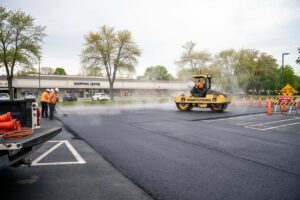
If you manage or own a commercial property in the GTA and you have never had a parking lot paving quote before, the number you get back is going to be different from anything you have budgeted for a driveway or a residential paving job. The scale is different. The specifications are different. The compliance requirements are different. And the consequences of choosing a contractor based on the lowest number rather than the correct scope are significantly more serious for a commercial lot that handles trucks, daily customer traffic and Ontario winters than they are for a residential driveway.
This guide covers what businesses across Toronto, Mississauga, Markham, Etobicoke, Vaughan and the wider GTA are actually paying for commercial parking lot paving in 2026, what drives the cost up or down, the Ontario-specific compliance requirements that most quotes either include vaguely or price separately without explaining why, and the questions that separate contractors who will build you a parking lot that lasts from those who will build you one that looks identical and fails in three to five years.
What a Commercial Parking Lot Actually Costs in Toronto in 2026
Commercial asphalt paving costs between C$4.00 and C$10.00 per square foot for new installations in the GTA in 2026. Toronto and GTA areas tend to run 10 to 15 percent higher than provincial averages because of labour costs, equipment logistics in dense urban environments, and the additional base preparation that GTA clay soils and freeze-thaw conditions require.
On a per-project basis, here is what that means for different lot sizes.
| Lot Size | Cars Accommodated | Estimated Project Cost |
|---|---|---|
| 2,000 sq ft | 6 to 8 cars | $10,000 to $20,000 |
| 5,000 sq ft | 15 to 18 cars | $22,000 to $45,000 |
| 10,000 sq ft | 30 to 35 cars | $42,000 to $90,000 |
| 25,000 sq ft | 80 to 90 cars | $95,000 to $220,000 |
| 50,000 sq ft | 160 to 180 cars | $180,000 to $450,000+ |
The average asphalt parking lot project overall runs around $75,000, with typical commercial projects ranging from $10,000 to $150,000 depending on the scope, the site conditions and the specification required for the traffic the lot needs to handle. A 10,000 square foot lot, enough for about 50 cars, usually lands between $25,000 and $45,000 for standard commercial traffic conditions.
The wide range in every size category is not arbitrary. It reflects the difference between a project that is scoped correctly for long-term performance and one that is scoped to produce the lowest possible headline number. Understanding what makes a GTA commercial paving project cost more or less per square foot is what allows you to read a quote accurately rather than just comparing numbers.
Why Commercial Paving Is a Fundamentally Different Conversation From Residential
The core difference is not just scale. It is engineering.
A residential driveway carries personal vehicles, occasional moving trucks and moderate seasonal traffic. The base and asphalt thickness requirements for a residential application are designed around this loading scenario. A commercial parking lot carries the same vehicles plus delivery trucks, service vehicles, heavy equipment deliveries, and daily high-frequency foot traffic patterns that residential surfaces never face.
A small residential driveway and a large commercial parking lot may both involve asphalt, but the preparation, materials, and labour involved are completely different.
Asphalt thickness is the most direct expression of this difference. Cars require approximately three inches of asphalt compacted over a properly prepared base. Commercial lots that receive delivery trucks, refuse collection vehicles, heavy equipment servicing or regular truck traffic need four to six inches or more in the zones where those loads occur. Each additional inch beyond the residential specification adds approximately $0.50 to $1.00 per square foot in material cost. A lot priced at $4.00 per square foot that uses the residential thickness specification for a site receiving daily delivery vehicles is not comparable to a lot priced at $6.50 per square foot that uses the correct commercial thickness. The first one fails in heavy-traffic zones within three to five years. The second one performs as expected across its design lifespan.
Base preparation is the second major divergence. Commercial lots require engineered base design that accounts for the subgrade soil conditions, the expected loading, the drainage design and the freeze-thaw environment. Site preparation adds $1.50 to $5.00 per square foot before any paving material is placed on a commercial project. That site preparation cost reflects real work: soil testing, excavation to the correct depth, granular base material installation to the engineered specification, compaction to the required density standard. Skipping or reducing any of these steps produces a lower quote and a parking lot that begins failing under commercial loading before the warranty period ends.
The Five Factors That Move Your Toronto Parking Lot Quote
1. Site Preparation and Existing Conditions
A vacant lot that has never been paved requires complete excavation and base installation from scratch. An existing lot being repaved may need the old surface removed, base assessment and repairs before any new asphalt goes down. If the existing base is structurally sound, a resurfacing or overlay approach can work. Commercial resurfacing typically ranges from C$2.50 to C$4.50 per square foot, substantially less than full replacement.
Rocky, wet, or unstable soil adds $1.00 to $2.00 per square foot for stabilization before paving begins. GTA clay soils across Scarborough, Etobicoke, North York and suburban Mississauga can require additional base depth to manage the frost heave behaviour of clay-heavy ground under repeated freeze-thaw cycling.
2. Drainage Engineering
This is the cost component most Toronto business owners are surprised by until they see what happens when it is missing.
Drainage infrastructure typically adds 15 to 30 percent to the base paving cost on a commercial project. On a $60,000 parking lot, that is $9,000 to $18,000 in drainage infrastructure. It is also the component that determines whether the lot holds up through GTA winters or becomes a liability of potholes, rutting and standing water within a few seasons.
Failing to address drainage issues early can spike infrastructure costs by up to 30 percent according to 2026 industry standards. The specific reason this matters in the GTA more than in other Canadian cities is freeze-thaw frequency. Water that accumulates under or within an asphalt surface and freezes expands. In the GTA’s climate with repeated temperature crossings through winter, a poorly drained lot cycles through freeze-thaw dozens of times per season. That cycling is what turns minor drainage problems into structural pavement failures within two to three winters.
Proper drainage engineering on a commercial Toronto lot includes grading design that directs water away from the pavement surface and toward appropriate collection points, catch basin installation where needed and subsurface drainage provision where soil drainage is inadequate. The cost of getting this right at installation is always less than the cost of correcting it after the lot has failed.
3. Freeze-Thaw Climate Specification
Toronto’s specific climate imposes cost requirements that warmer Canadian cities do not face at the same scale. Freeze-thaw climates can increase total project costs by 10 to 25 percent compared to milder-climate equivalents. This premium reflects the additional base depth, the thicker asphalt specification and the drainage engineering that the GTA’s 30-plus annual freeze-thaw cycles demand. Cutting any of these specifications to reduce the quote produces a lot that performs adequately in the first summer and fails progressively from the first hard winter.
The road salt and winter damage context explains the chemical and physical mechanism in detail. Commercial lots are salt-loaded more heavily than residential driveways because municipal road salting vehicles treat the roads adjacent to commercial properties throughout the winter season, and delivery vehicles track that salt across the lot surface with every entry and exit. Road salt accelerates asphalt binder degradation, which is why commercial lots in the GTA that are not sealed regularly deteriorate faster than the same lots would in a lower-salt environment.
4. AODA Compliance Requirements
This is the Ontario-specific cost driver that most businesses are not aware of until they either receive a quote that includes it or they complete a lot without it and face enforcement action.
The Accessibility for Ontarians with Disabilities Act, or AODA, sets requirements for accessible parking in commercial facilities. ADA/AODA compliance runs $5,000 to $25,000 per lot, and in the GTA, failing to achieve AODA compliance on a newly paved commercial lot can result in significant enforcement costs that dwarf the original compliance investment.
AODA parking requirements for Ontario commercial properties include: the correct proportion of accessible spaces to total parking capacity, correct dimensions for accessible spaces and access aisles, surface conditions that meet accessibility standards including slope and texture requirements, accessible route connection from parking to the building entrance, and correct signage and markings.
A commercial paving contractor in Toronto should be familiar with AODA parking requirements and include compliance scope in the project assessment rather than treating it as an optional add-on. If a quote does not address AODA compliance, ask specifically.
5. Line Painting, Signage and Peripheral Scope
The paving cost covers the asphalt or concrete surface. The complete functional parking lot also requires line painting, accessible space markings, directional arrows, stop bars, signage posts and lighting infrastructure. These are typically priced separately from the paving work and collectively add $2,000 to $15,000 to a project depending on lot size and complexity.
Parking lot line painting and restriping in the GTA runs approximately $0.15 to $0.50 per linear foot for standard lines, with AODA-compliant accessible markings priced per space. For a full lot with new lines, accessible markings and directional signage, budget $0.10 to $0.30 per square foot of total lot area for the line work component.
Asphalt vs. Concrete for a Toronto Commercial Lot
The same comparison that applies to residential driveways applies to commercial lots, with two commercial-specific considerations that shift the decision.
Asphalt costs less upfront at C$4.00 to C$10.00 per square foot for commercial installations. Concrete costs more at roughly C$10.00 to C$15.00 or more per square foot for reinforced commercial slabs. For most commercial parking applications in Toronto, asphalt is the right material: it installs faster, handles GTA freeze-thaw movement more flexibly than rigid concrete, is repairable in sections and provides a strong cost-performance balance across its service life.
The concrete exception applies to specific high-load zones. Loading docks, heavy equipment staging areas and refuse vehicle routes carry loads that exceed what standard commercial asphalt specifications handle long-term. Concrete serves heavy-load zones like loading docks at $10 to $15 or more per square foot for reinforced slabs. Many GTA commercial lots combine asphalt across the main parking field with concrete slab construction in loading dock areas, which optimises cost across the full site.
For the full material comparison including freeze-thaw performance and 20-year cost of ownership, the asphalt versus interlocking pavers guide covers the decision framework in detail.
The Maintenance Math Every Toronto Property Manager Should Know
This is the piece that turns commercial parking lot paving from a pure capital expenditure into an investment decision with a clear return.
Preventive maintenance programs deliver ROI as high as 545 percent by extending pavement life and reducing major repair frequency. The specific maintenance rhythm for a well-built commercial asphalt lot in the GTA looks like this.
Sealcoating every two to three years at $0.20 to $0.38 per square foot protects the asphalt binder layer from UV degradation and road salt penetration. For a 10,000 square foot lot, that is $2,000 to $3,800 every two to three years. Regular upkeep is far cheaper than early replacement.
Crack filling as cracks develop, annually or bi-annually, prevents water infiltration that leads to base failure. The unit cost of crack filling is a fraction of the resurfacing cost that becomes necessary when cracks are left until they connect across a significant area of the lot.
Resurfacing at the 8 to 12 year mark for an initially well-built lot extends the total service life by another 8 to 12 years without the full base reconstruction cost of replacement. Commercial resurfacing at $2.50 to $4.50 per square foot against a full replacement cost of $4.00 to $10.00 per square foot is a straightforward comparison when the base is still sound.
A commercial lot that receives appropriate maintenance across its service life has a total cost of ownership over 20 to 25 years that is significantly lower than a lot that is built, neglected and replaced. The business case for a proper maintenance program is stronger than most commercial property owners realise until they compare the numbers over a full lifecycle.
Three Questions That Separate Good Commercial Paving Contractors From Bad Ones
These three questions, asked before any quote is accepted, reveal whether a contractor is scoping the project correctly or pricing to win and adjusting later.
What base depth and granular base specification are you using for this site? The correct answer for a Toronto commercial lot with standard vehicle traffic is a minimum of 8 to 12 inches of compacted granular base over the sub-grade. A vague answer or a refusal to specify is a warning. Two quotes that both say $4 per square foot can be completely different projects: one built to spec and one cutting corners that will manifest as pavement failure within five years.
What is your drainage design for this lot? Every commercial paving quote for a Toronto property should include a drainage plan or reference an engineer’s drainage design. A contractor who proceeds to quote without discussing drainage has either included it without explanation or has not addressed it at all. Ask which.
What does your AODA compliance scope include? A contractor familiar with Ontario commercial paving knows the AODA requirements without being prompted. A contractor who does not know what AODA is should not be paving a commercial lot in Ontario.
Getting a Commercial Parking Lot Quote in the GTA
My Property Care provides commercial and residential paving services across Toronto and the GTA with site assessment, honest scope definition and flat-rate quoting before any work begins. Whether you are building a new commercial lot, resurfacing an existing one or assessing whether repair or replacement is the right decision for a lot that has deteriorated, every project starts with an accurate assessment of what the site actually needs.
For businesses comparing residential driveway costs against commercial lot pricing, the 2026 GTA driveway paving cost guide explains the pricing range for residential work across different materials for context.
Call 289-301-0925 or fill in the quote form to arrange a site assessment for your commercial property. We assess the site, confirm the scope and provide a clear price before any work is committed.
Published: September 2026 | My Property Care serves commercial and residential clients across Toronto, Mississauga, Markham, Etobicoke, Vaughan, Thornhill, Richmond Hill, North York, Scarborough, Brampton and Oakville.